

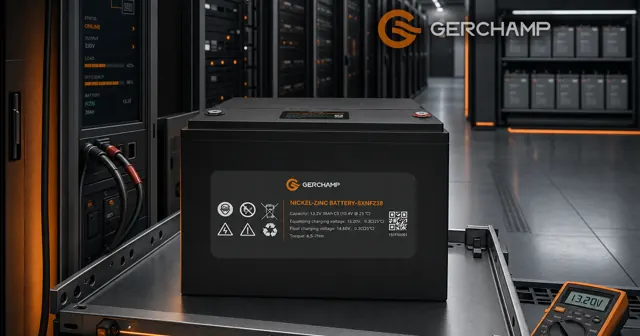
In data centers where power density continues to rise, UPS battery selection is no longer solely about energy storage capacity. Factors such as power output, response speed, safety, temperature adaptability, and lifecycle costs must also be evaluated. In data centers where power density continues to increase, the selection of UPS batteries is no longer solely based on energy storage capacity; instead, it requires a comprehensive evaluation of power output, response speed, safety, temperature adaptability, and lifecycle cost.
Therefore, Nickel-Zinc Battery vs Other Battery Technology can help us better understand the potential contributions of nickel-zinc batteries to next-generation critical applications. This article will compare nickel-zinc batteries with lead-acid batteries.
Power and Discharge Capability
For a UPS backup battery, the ability to deliver power quickly is often as important as its total energy capacity.
During a utility interruption, the battery must provide current to the UPS within a very short period. High discharge capability and stable voltage therefore play an important role in UPS performance.
Lead-acid batteries can provide reliable backup power, but their available capacity and voltage performance are affected by discharge rate, internal resistance, temperature, and battery condition.
Nickel-Zinc batteries use a different electrochemical system and are designed to support high-rate discharge.
For example, the Gerchamp 8XNFZ38 Nickel-Zinc Battery supports up to 10C discharge, making high-power output one of its key characteristics for UPS applications.
This highlights an important point in the NiZn vs Lead Acid comparison: for short-duration UPS backup, battery performance is not simply about how much energy is stored, but also how effectively that energy can be delivered when required.
Internal Resistance and UPS Response
Internal resistance is another important consideration when comparing Nickel-Zinc vs Lead-Acid batteries.
When a UPS switches from utility power to battery power, the battery must respond rapidly to a high-current demand. Higher internal resistance can result in greater voltage drop and energy loss during high-current discharge.
This becomes increasingly relevant as AI and high-density computing introduce more dynamic power requirements.
Gerchamp’s Nickel-Zinc battery design focuses on low internal resistance and high-rate discharge capability, supporting rapid power delivery during UPS backup events.
Therefore, when evaluating a UPS battery, internal resistance should be considered alongside capacity, rather than treating capacity as the only measure of battery performance.
Charge Acceptance and Recovery
UPS batteries normally remain on standby but must recover after a discharge event.
Charge acceptance therefore affects how quickly a battery can return to an available state and how effectively the system can respond to repeated power disturbances.
Lead-acid batteries have established charging characteristics, but their ability to accept high charging rates is generally more limited than that of technologies designed specifically for high-rate operation.
Nickel-Zinc batteries use a different electrochemical system and can provide strong 10C discharge performance for high-power backup applications, while also achieving fast charging through design.
For data center UPS systems that may experience repeated power events, evaluating both discharge capability and charging recovery provides a more complete picture of battery performance.
Lifetime and Maintenance
Battery lifetime is an important part of the long-term economics of a data center UPS.
The service life of lead-acid batteries can be strongly affected by operating temperature, float conditions, depth of discharge, and maintenance practices. In particular, elevated temperatures can accelerate aging and reduce the service life of VRLA batteries.
Battery replacement also involves more than the cost of the battery itself. Large data centers may need to consider transportation, labor, maintenance windows, disposal, and operational disruption.
The Gerchamp nickel-zinc battery, under appropriate operating conditions – taking the 8XNFZ38 model as an example – can have a design service life of up to 15 years.
For this reason, NiZn vs Lead Acid should be evaluated using lifecycle considerations rather than initial purchase price alone.
Operating Temperature
Temperature has a significant influence on battery performance and lifetime.
Lead-acid batteries are relatively sensitive to temperature. Higher temperatures can accelerate degradation, while lower temperatures can reduce available capacity and discharge performance.
The Gerchamp 8XNFZ38 Nickel-Zinc Battery has a published operating temperature range of –20°C to 55°C.
A wider operating temperature range can provide greater flexibility when batteries are deployed in different environments, although actual system design should always consider the product’s specific charging, discharging, and environmental requirements.
Space and Weight
Space and weight are increasingly important in modern data center battery deployments.
Traditional lead-acid batteries generally have lower energy density and higher weight than many newer battery technologies. As a result, larger UPS backup requirements can require substantial battery rooms, racks, and structural capacity.
Gerchamp’s published specifications for the 8XNFZ38 indicate a volumetric energy density of 129.4 Wh/L and a gravimetric energy density of 64.3 Wh/kg.
This makes Nickel-Zinc particularly relevant for applications where battery footprint or structural load is a constraint.
For existing data centers, this advantage can also become important during battery replacement or infrastructure upgrades, where the available battery space and floor loading capacity may already be limited.
Safety Considerations
Safety is a critical factor in any data center UPS battery selection.
Lead-acid and Nickel-Zinc batteries use different chemical systems and therefore have different safety characteristics.
Lead-acid batteries use sulfuric acid as their electrolyte. Depending on the battery type and operating conditions, charging can generate hydrogen and oxygen, making appropriate ventilation and installation practices important.
Nickel-Zinc batteries use an aqueous alkaline electrolyte rather than a flammable organic electrolyte.
Gerchamp states that its Nickel-Zinc battery did not experience thermal runaway under UL9540A test conditions. This aqueous chemistry is one of the key characteristics behind the technology’s safety profile.
For data centers, battery safety should be evaluated as part of the wider facility design, including fire protection, ventilation, environmental control, and operational requirements.
NiZn vs Lead Acid: Which Battery Is Right for Data Center UPS?
There is no universal answer to the NiZn vs Lead Acid question.
Lead-acid batteries remain a practical choice for many UPS systems because of their maturity, established supply chain, and extensive field experience. For facilities with stable backup requirements and existing lead-acid infrastructure, continuing to use VRLA batteries may still be appropriate.
Nickel-Zinc becomes particularly relevant when a UPS application places greater emphasis on:
- High-rate power delivery
- Fast transient response
- Space efficiency
- Lower system weight
- Wider operating temperature capability
- Long-term battery lifecycle
- Enhanced battery safety characteristics
The decision should ultimately be based on the UPS architecture, required backup time, discharge profile, environmental conditions, available space, maintenance strategy, and total cost of ownership.
NiZn vs Lead Acid for the Next Generation of Data Centers
The role of a UPS battery is evolving as data centers move toward AI workloads, higher power density, and increasingly dynamic electrical loads.
Lead-acid technology remains an established solution, but modern UPS requirements are placing greater emphasis on power performance, response speed, safety, space utilization, and lifecycle economics.
NiZn vs Lead Acid is therefore not simply a comparison of two battery chemistries. It is a comparison of two approaches to meeting the backup power requirements of modern critical infrastructure.
Nickel-Zinc batteries offer a different technology path, combining high-rate discharge capability, aqueous alkaline chemistry, and a compact design with the potential to address several requirements of next-generation data center UPS systems.
For data center operators evaluating their next UPS battery deployment or replacement project, NiZn provides an alternative technology worth evaluating alongside established lead-acid solutions.