

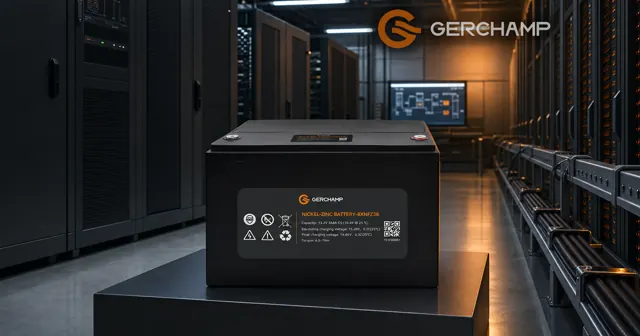
As AI, high-performance computing, and cloud services continue to drive data center expansion, backup power systems are facing new challenges. In the past, data centers evaluating UPS batteries typically prioritized capacity, runtime, and upfront cost. However, as critical infrastructure scales up and safety requirements intensify, battery safety is becoming a decisive factor in next-generation data center design.
For modern data centers, battery selection is no longer just about “how much energy can be stored” — it is about “whether that energy can be managed safely and reliably.”
The Logic Behind Data Center Battery Selection Is Changing
For decades, VRLA batteries have been a common choice for data center UPS applications, favored for their mature technology, broad installed base, and lower initial cost.
In traditional data center environments, battery evaluation typically centered on a few core questions:
-
Does it meet the required runtime?
-
Is it compatible with the existing UPS system?
-
Is the upfront investment acceptable?
However, as data centers move toward higher power density and greater criticality, operators are re-examining conventional battery solutions.
Today, battery selection requires consideration not only of performance specifications, but also:
-
Impact on the data center facility environment
-
Long-term operational reliability
-
Potential operational disruption risks
The reason is straightforward: a UPS battery does not operate in isolation. As part of critical power infrastructure, the safety of the battery system directly affects the business continuity of the entire data center.
Safety is therefore transitioning from a technical specification to a fundamental criterion in data center infrastructure design.
Thermal Runaway Risk Is Redefining Battery Safety Standards
As high-energy-density battery technologies advance, thermal runaway has become an increasingly prominent concern in the data center backup power sector.
Thermal runaway is not a single point of failure, but a chain reaction of electrochemical and thermal events once triggered. In mission-critical environments, any risk that could compromise power continuity must be assessed and mitigated in advance. This is driving the industry to examine the intrinsic safety differences across battery chemistries.
Compared to conventional solutions, the direction of next-generation UPS battery design is shifting from simply increasing energy storage capacity toward reducing risk at the chemical level.
For a more detailed technical analysis of why nickel-zinc batteries offer higher intrinsic safety and how they differ from other chemistries regarding thermal runaway risk, Gerchamp has published a dedicated analysis in the article Why Gerchamp Nickel-Zinc Batteries Don’t Have Thermal Runaway
Nickel-Zinc Batteries: Enhancing Backup Power Safety at the Chemical Level
Nickel-zinc battery (8XNFZ38,8XNFG90) offer a new technology pathway for data center backup power. Unlike some high-energy-density batteries that rely on flammable organic electrolytes, nickel-zinc batteries use a water-based alkaline electrolyte that provides inherent safety advantages at the chemical level. This technical characteristic enables nickel-zinc batteries to mitigate thermal runaway risks and offer a safer backup power option for mission-critical applications.
For data centers, this means:
-
Reduced risk of safety incidents
-
Fewer complex fire suppression requirements
-
A battery choice better suited for critical infrastructure
More importantly, nickel-zinc batteries represent a different design philosophy: safety should not be an afterthought or a protective layer added after the fact — it should be built in from the chemistry itself.
Safety Does Not Mean Sacrificing Performance
For data centers, safety cannot be divorced from operational requirements. Backup power must not only offer strong safety attributes but also meet the demands of critical loads for fast response and stable power delivery. As AI data centers and high-density computing environments evolve, UPS systems need to deliver rapid, high-current output at critical moments to handle transient power demand fluctuations.
Nickel-zinc batteries, with their high-rate discharge capability, can deliver robust power output when needed — enabling safety and performance to coexist in modern UPS applications. In other words, the future of data center battery selection is not a trade-off between safety and performance, but rather finding a technology that meets mission-critical requirements while maintaining higher safety standards.
For a comprehensive overview of how nickel-zinc batteries meet data center backup power requirements and their advantages in safety and reliability, Gerchamp has published further analysis in the article 《The Safest and Most Reliable Backup Power Option for Data Centers — Nickel-Zinc Batteries》
The Future of UPS Battery Selection: Safety as a Core Standard
As data centers continue to evolve, backup power systems are entering a new phase. The data centers of the future will not only ask: “How long can this battery provide backup power?” They will also ask: “Can this battery technology operate safely and reliably over the long term in a critical environment?”
For mission-critical facilities, battery safety is no longer just an added benefit — it is becoming a determining factor in technology selection. Nickel-zinc batteries, through their distinct chemistry, offer a new direction for next-generation UPS backup power: meeting high-reliability requirements while fundamentally enhancing system safety.