

Introduction:
Whether it’s severe cold or blazing heat, temperature has always been one of the greatest challenges to battery reliability. Many critical facilities like edge data centres, telecom base stations are located precisely in regions with harsh temperature conditions. Traditional lead‑acid batteries suffer from drastic capacity loss in the cold and dramatically shortened service life in the heat. Lithium ion batteries carry the risk of thermal runaway at high temperatures.
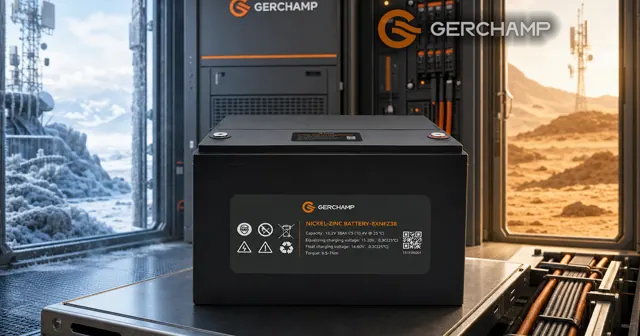
The Gerchamp nickel zinc battery (e.g. 8XNFZ38), with its unique nizn battery chemistry, operates reliably across a wide temperature range from -20°C to +55°C. This capability makes the Gerchamp nizn battery the most trustworthy rechargeable battery for extreme natural environments. Gerchamp offers a range of NiZn battery models for different UPS applications, including the 8XNFG90 alongside the 8XNFZ38.
The Cold Challenge: Who “Strikes” at -20°C
When ambient temperature drops below freezing, most battery technologies begin to perform poorly. Sealed lead‑acid batteries suffer a sharp drop in usable capacity at -20°C, along with a sharp rise in internal resistance, making high‑current discharge almost impossible. Worse, the electrolyte in lead‑acid batteries may freeze at low temperatures, causing case rupture and irreversible damage.
Lithium ion batteries perform slightly better in cold discharge than lead‑acid, but the vast majority of lithium ion batteries are prohibited from charging below 0°C – because low‑temperature charging causes lithium plating, which can pierce the separator and create a short circuit.
The Heat Challenge: The Trade‑off Between Long Life and Safety
Heat often damages batteries more insidiously than cold. The corrosion reaction in lead‑acid batteries accelerates exponentially with temperature – for every 10°C rise, their service life roughly halves. At 55°C, a typical VRLA battery may dry out, corrode its plates, and lose all capacity within six months. Worse, high temperatures worsen electrolyte leakage and acid mist release from lead‑acid units, corroding nearby electronics. Ion batteries (especially lithium ion) also face severe challenges at 55°C: electrolyte decomposition, gas generation, and eventually thermal runaway fires.
Deployment Freedom Across the Temperature Spectrum
The -20°C to +55°C operating window of the nickel zinc battery is not just a number; it represents real deployment flexibility.
Outdoor and natural environments: Extreme outdoor locations often lack climate‑controlled rooms – winter winds are brutal and summer sun is intense. The nickel zinc battery can adapt to these extreme temperature conditions. In contrast, lead‑acid and lithium batteries will either freeze or overheat; their performance in extreme temperatures is inferior to that of the nickel zinc battery.
Telecom base stations in less developed regions: Many remote base stations lack stable power for air conditioners, or operators disable cooling to save costs. The wide‑temperature capability of the nickel zinc battery allows it to run reliably for years in simple shelters or even outdoor cabinets, greatly reducing battery replacement frequency and maintenance costs.
A Future‑Ready Wide‑Temperature Battery Technology
As a mature, mass‑producible and field‑proven nickel zinc solution, the nickel zinc battery solves real‑world temperature problems today. It offers power supplies for edge data centre equipment a reliable option without thermal management. Its nizn battery chemistry uses a stable water‑based electrolyte and robust nickel‑zinc active materials that do not easily decompose. More importantly, high temperatures do not trigger thermal runaway in Ni‑Zn – its charge efficiency remains stable over the entire temperature range, without the positive feedback loop seen in lithium batteries where “the higher the temperature, the more severe the side reactions”. For uninterruptible power supply systems located in hot regions (such as the Middle East, Southeast Asia, or desert solar farms), choosing a nickel zinc battery means that dedicated air conditioning can be omitted or cooling requirements can be significantly reduced, while achieving higher system reliability.
Conclusion
For any backup power system that must operate reliably between -20°C and +55°C, the nickel zinc battery is the most dependable and hassle‑free rechargeable battery choice today. Whether for AI data centres, telecom base stations, or outdoor critical facilities, choosing a nickel zinc battery means securing true stable backup power across the entire temperature spectrum. On your next battery replacement cycle, consider nickel zinc battery cabinets for your ups battery system – and let temperature no longer be a hidden threat.