

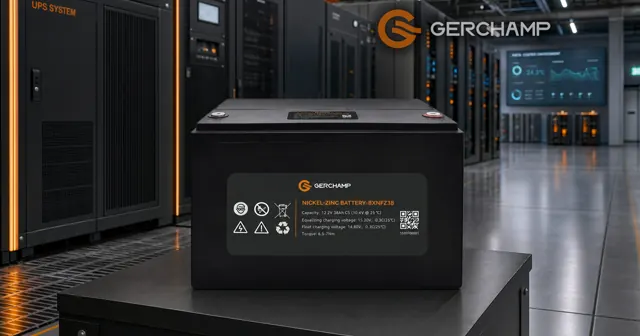
With the rapid development of AI data centers and high-density computing facilities, UPS backup batteries are facing higher requirements for safety and system design.
Therefore, Nickel-Zinc Battery vs Other Battery Technology can help us better understand the potential impact of nickel-zinc batteries on key next-generation technological fields; this article will compare nickel-zinc batteries with lithium-ion batteries.
The comparison of NiZn vs Lithium is not simply about comparing capacity, weight, or energy density. Instead, it requires further attention to the differences between the two chemistries in terms of safety, thermal management, battery management, and UPS system design.
For short-duration, high-reliability Data Center UPS Backup scenarios, these system-level factors are particularly important.
Battery Safety
Battery safety is one of the most noteworthy factors in the NiZn vs Lithium comparison.
Lithium-ion batteries typically use organic electrolytes. The specific safety characteristics vary among different lithium chemistries—for example, LFP generally offers better thermal stability than NMC—but overall, lithium-ion batteries still require systematic management of risks such as thermal runaway, overcharge, overheating, and cell abnormalities.
Therefore, a Lithium Battery System in a Data Center UPS typically relies not only on the cells themselves, but also on a combination of BMS, temperature monitoring, protection strategies, and thermal management systems to achieve safe operation.
NiZn, on the other hand, uses an aqueous alkaline electrolyte, which is fundamentally different in chemistry from lithium-ion batteries that use organic electrolytes.
For UPS backup power, this difference has practical engineering significance. Gerchamp’s Nickel-Zinc Battery does not experience thermal runaway under UL9540A test conditions, and this aqueous chemistry is also an important foundation for its intrinsic safety characteristics.
This means that when comparing NiZn vs Lithium, safety should not be understood merely as “whether the battery will fail,” but also as what impact a battery anomaly might have on the entire data center.
For critical infrastructure, battery safety further affects fire protection systems, equipment layout, ventilation, environmental control, and operations management.
The advantage of NiZn, therefore, is not simply that it has a higher safety parameter, but that its chemistry itself offers a different safety pathway.
Battery Temperature
Temperature is also an important component of battery safety design.
Lithium-ion batteries typically require strict control of operating temperatures. Excessive temperatures may accelerate aging and increase thermal management stress; under abnormal conditions, heat may further affect adjacent cells.
Therefore, a Lithium UPS Battery System often needs to continuously monitor battery status through temperature sensors, BMS, and thermal management systems.
NiZn also requires reasonable temperature management, but Gerchamp’s 8XNFZ38 has an operating temperature range of –20°C to 55°C, providing greater flexibility for different deployment environments.
For data centers, a wider temperature tolerance means not only that the battery can operate in more environments, but also that designers can reassess environmental control and battery deployment requirements from a total-system perspective.
Battery Management System
Battery Management System (BMS) is a critical component of modern Lithium Battery Systems.
Because lithium-ion batteries require continuous monitoring of cell voltage, temperature, SOC, SOH, and charge/discharge status, the BMS typically undertakes key tasks such as battery protection, status monitoring, and operational control.
For data center UPS, this means that the system performance of lithium batteries depends not only on the cells themselves, but also heavily on:
- Cell-level monitoring
- Voltage and temperature protection
- SOC and SOH estimation
- Overcharge and over-discharge protection
- Thermal management
- Fault detection and system protection
This system-level management capability is one of the important reasons why Lithium Batteries can be applied in critical infrastructure.
However, from another perspective, the BMS is not merely an add-on function, but an integral part of the safety design for lithium battery systems.
NiZn can also incorporate a BMS (Battery Monitoring System) for UPS to monitor battery status in real time, but its aqueous alkaline chemistry means that system safety does not rely entirely on complex thermal management mechanisms.
This forms an important difference in the NiZn vs Lithium comparison:
A Lithium Battery System typically needs to build a complete safety system through cells, BMS, and thermal management together, whereas NiZn can start with a safe chemistry and then use BMS to achieve more complete status management and system protection.
For data center operators, this difference needs to be considered within the overall UPS architecture.
The battery system does not operate as an independent device; rather, together with the UPS host, BMS, power distribution, fire protection, and environmental control systems, it forms part of the critical infrastructure.
Therefore, when choosing between NiZn Battery for Data Center UPS and Lithium Battery, what needs to be evaluated is not just the battery itself, but also the overall system design complexity, protection logic, and facility-level safety requirements.
NiZn vs Lithium: A Different Approach to UPS Backup Power
For next-generation data centers, UPS battery technology is evolving from a pure energy storage device into an integral part of critical infrastructure.
Lithium Batteries have already established an important market position based on energy density and cycle performance, while Nickel-Zinc Batteries offer a technical alternative from a different direction.
Especially in Data Center UPS scenarios where intrinsic safety, thermal runaway risk, and system-level safety design are of high concern, NiZn’s aqueous alkaline chemistry provides unique advantages.
Therefore, for data center operators evaluating next-generation UPS Backup Batteries, NiZn does not need to beat Lithium on every metric.
What truly matters is: when safety becomes a design parameter as important as performance, can NiZn offer a battery technology pathway that is more suitable for critical infrastructure?
For Data Center UPS that emphasize safety, reliability, and long-term operation, this is precisely the most worthwhile direction for further study in the NiZn vs Lithium comparison.