

Introduction
The global data center UPS market is projected to grow from USD 7.3 billion in 2025 to nearly USD 12 billion by 2034, fueled by AI workloads, hyperscale cloud facilities, and edge computing. At the same time, average rack power density is climbing from 5–10 kW to 30–80 kW, with some AI deployments exceeding 100 kW per rack. These trends demand more from backup battery for UPS than ever before.
Yet a UPS is only as reliable as the battery inside it. The power electronics—rectifiers, inverters, static switches—are well understood and largely commoditized. The real differentiator, and the source of most failures, is the battery chemistry. A well‑designed UPS paired with the wrong battery will still suffer from thermal runaway, space waste, voltage sag, or frequent replacement. Conversely, a properly chosen battery can turn the entire backup system into a safe, dense, and low‑cost asset.
So when you evaluate a backup UPS system in 2026, your first and most important decision is not which UPS brand, but which battery chemistry to deploy. Here are five critical features to look for in that battery.
Backup battery needs to be safe enough
Battery fires are the number one cause of UPS system failures that escalate into facility disasters. The safety of a backup UPS system is determined not by the cabinet or the BMS alone, but by the fundamental chemistry of the cells.
Lead‑acid batteries can generate hydrogen and oxygen during overcharge, leading to explosion risks. Lithium‑ion (including LFP) uses flammable organic electrolytes; when abused, they enter thermal runaway — a self‑sustaining exothermic reaction that releases toxic smoke and jet flames. Even with sophisticated Battery Management Systems (BMS), the risk cannot be eliminated; it can only be monitored.
Nickel‑zinc (NiZn) batteries are fundamentally different. They use a non‑flammable aqueous potassium hydroxide (KOH) electrolyte. There is no fuel to burn. Under extreme abuse—nail penetration, crushing, overcharge, or fire exposure—NiZn does not ignite or explode. Instead, the water‑based electrolyte evaporates, absorbing latent heat and gradually increasing internal resistance. The cell “dries out” passively, without thermal runaway propagation. This intrinsic safety is validated by UL 9540A certification at the battery‑level.
Backup battery needs to be compact enough
Space is revenue in modern data centers. Every square meter taken by batteries is a square meter taken from IT equipment. Power density—measured in Wh/L (volumetric) and Wh/kg (gravimetric)—is a direct measure of how much backup energy you can pack into a given footprint.
Lead‑acid (VRLA) batteries offer only 30–50 Wh/kg and around 80‑100 Wh/L. To support a 5‑minute high‑rate discharge for a 100 kW load, you need multiple heavy cabinets, often exceeding floor load limits and requiring structural reinforcement.
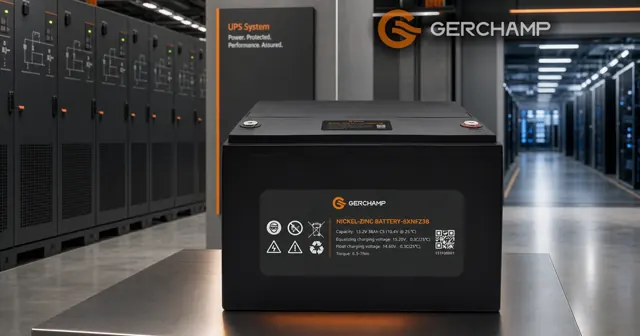
Nickel‑zinc delivers 129.4 Wh/L and 64.3 Wh/kg in the 8XNFZ38 model. That is roughly twice the power density of lead‑acid and comparable to LFP in energy, but with much higher power capability. For the same backup duration, a NiZn system can be 50% smaller and 66% lighter than VRLA. This allows you to repurpose gray space for additional server racks, directly improving ROI. Gerchamp also offers other NiZn battery models, such as the 8XNFG90, to meet different capacity and application requirements.
Backup battery needs to be Powerful enough
AI and HPC workloads are not steady‑state; they create extreme transient pulses—millisecond‑scale current surges and rapid oscillations between peak and idle. A backup battery must respond instantly without voltage collapse.
Lead‑acid batteries suffer from Peukert’s effect and diffusion limitations. At high discharge rates (e.g., 5C or 10C), their effective capacity plummets to 40‑50% of rated, meaning you must massively oversize the system to achieve the required runtime.
Lithium‑ion has better rate capability but still faces solid‑phase diffusion constraints, causing voltage sag under heavy load. Moreover, repetitive pulse loads generate localized hot spots, forcing the BMS to throttle performance or shut down to avoid thermal runaway.
Nickel‑zinc excels here. Its redox reaction is surface‑dominated with minimal diffusion limitations, delivering instantaneous current upon load step. It supports continuous 10C discharge while maintaining a flat voltage platform for over 5 minutes—critical during the 5‑10 minute window before diesel generators kick in. This eliminates the need for oversized battery plants and ensures stable DC bus voltage, preventing server PSU tripping.
Backup battery needs to be durable enough
Battery performance and lifespan are highly temperature‑sensitive. Narrow operating ranges force operators to invest heavily in cooling (for heat) or heating (for cold), driving up both CapEx and OpEx.
Lead‑acid loses about 50% of effective capacity at -20°C, and every 10°C above 25°C halves its service life. Lithium‑ion cannot be charged below 0°C without risking lithium plating; it requires mandatory pre‑heating systems in cold climates, adding energy consumption and complexity.
Nickel‑zinc operates efficiently across -20°C to +55°C for discharge, and 0°C to +40°C for charge. At -20°C, it retains over 80% of its capacity at 0.2C rate, with a stable voltage platform. This thermal resilience eliminates the need for battery room heating or intensive cooling, simplifying enclosure design and reducing utility bills.
What to look for: Check the full operating temperature range (both charge and discharge). A wider range means lower infrastructure costs and more flexible deployment—outdoor, rooftop, or unconditioned spaces.
Backup battery needs to be cost-effective enough
The purchase price is only a fraction of the battery’s true cost. TCO includes replacement cycles, maintenance, cooling/heating energy, fire suppression, and disposal.
Lead‑acid typically lasts 3‑5 years, requiring 2‑3 full replacements over a 15‑year facility lifespan. Each replacement involves labor, downtime risk, and disposal fees. Lithium‑ion can last 10‑15 years but demands expensive active thermal management, gas‑based fire suppression, and complex recycling processes.
Nickel‑zinc is engineered for a 15‑year design life at 25°C, with 500 cycles at 1C 100% DoD or 800 cycles at 50% DoD. Its integrated BMS provides real‑time monitoring of voltage, temperature, and internal resistance, shifting maintenance from reactive to predictive. With over 90% recyclability and no lead, cadmium, or other hazardous substances, NiZn complies with EU Battery Regulation 2023/1542 and RoHS, simplifying end‑of‑life handling and aligning with ESG goals.
Conclusion
When you choose a backup UPS system for your data center, hospital, or industrial facility, do not be distracted by UPS brand names or fancy inverter efficiencies. The real decision lies in the battery chemistry. The five features that truly matter—intrinsic safety, power density, high‑rate discharge, wide temperature range, and low TCO—are all determined by the electrochemical system inside the cells.
Legacy lead‑acid fails on density and longevity. Lithium‑ion introduces unacceptable fire and complexity risks. Nickel‑zinc uniquely combines all five advantages: zero thermal runaway, twice the density of lead‑acid, 10C discharge, -20°C to +55°C operation, and a 15‑year design life. For mission‑critical environments where downtime is not an option, NiZn is the battery chemistry that makes your backup UPS system truly reliable for the AI era.