

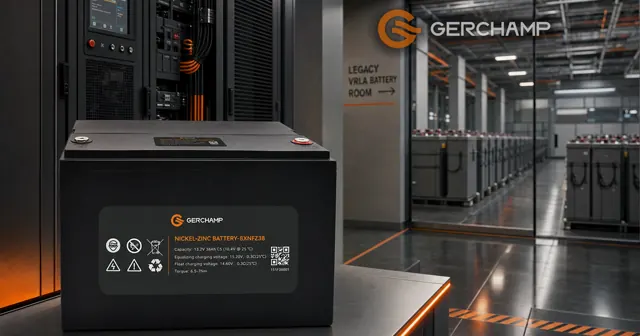
For many data centers, replacing UPS batteries is still treated as a routine maintenance task: remove the aging VRLA batteries, install new ones, and continue operating with essentially the same system.
But for aging data centers, the next battery replacement cycle can represent something more important.
It can be an opportunity to reconsider whether the existing battery technology still fits the infrastructure, power requirements, available space, safety expectations, and long-term operating goals of the facility.
This is where Nickel Zinc Battery technology provides a different path.
Rather than treating battery replacement as a like-for-like procurement exercise, Nickel Zinc Battery can help data center operators address several of the constraints associated with aging VRLA systems, including weight, space utilization, power performance, safety, maintenance, and replacement frequency.
Why VRLA Replacement Is Becoming an Infrastructure Decision
VRLA batteries remain widely used in UPS systems because they are mature, familiar, and supported by an established infrastructure ecosystem.
However, many data centers operating today were designed around requirements that are no longer the same as those of modern high-density facilities.
As computing capacity increases and facilities enter their second or third infrastructure lifecycle, battery rooms may face increasingly tight space constraints, floor loading limitations, higher maintenance requirements, and growing pressure to improve the efficiency of existing infrastructure.
At the same time, replacing VRLA with another generation of VRLA does not fundamentally change these constraints.
The battery is new, but the underlying infrastructure requirements remain largely the same.
For a more detailed look at why aging AIDC facilities are reconsidering conventional battery systems, see 《Nickel-Zinc: A Better Backup Upgrade for Legacy AIDC》.
What Should Be Considered When Replacing VRLA?
A successful VRLA replacement should not be evaluated only by battery capacity or purchase price.
The more important question is whether the replacement battery can improve the overall backup power system without creating new infrastructure constraints.
For an existing data center, this means considering several factors together: power capability, battery weight, installation space, floor loading, safety, maintenance requirements, service life, and compatibility with the existing UPS environment.
This is why VRLA replacement is increasingly becoming a system-level decision rather than a simple battery procurement exercise.
A structured approach can help operators determine whether they should simply replace the existing batteries or use the replacement cycle as an opportunity to upgrade the backup power architecture. For more on this approach, see 《VRLA Replacement Framework for Data Center Upgrades》.
The Hidden Infrastructure Cost of Keeping VRLA
The cost of a UPS battery is only one part of the replacement equation.
VRLA systems can also create costs associated with installation, maintenance, replacement cycles, space utilization, and structural requirements. In aging facilities, these indirect factors can become increasingly important because the physical infrastructure is already fixed.
Battery weight is a particularly relevant example.
A conventional VRLA installation can represent a significant concentrated load within a battery room. If floor loading capacity becomes a constraint, operators may need to consider structural assessment or reinforcement before additional battery capacity can be deployed.
Replacing the batteries with another equally heavy VRLA configuration does not solve the underlying problem.
Gerchamp’s analysis of aging sites shows how reducing battery weight can provide a different approach: instead of reinforcing infrastructure to accommodate the battery, the battery itself can be redesigned to reduce the load. See 《Reduce Floor Load: VRLA Replacement for Aging Sites》.
The same principle applies to lifecycle cost. A battery replacement decision should consider not only the initial purchase price, but also maintenance, installation, replacement frequency, and the operational impact of repeated battery replacement. These factors can significantly influence the total cost of ownership over the life of a data center.
For a deeper examination of these factors, see 《Hidden Costs of Lead-Acid Battery Replacement in Data Centers》.
Why Nickel Zinc Battery Provides a Different Replacement Path
This is where Nickel Zinc Battery technology becomes relevant.
Nickel Zinc Battery combines a nickel-based positive electrode, zinc-based negative electrode, and aqueous alkaline electrolyte to provide a different performance and safety profile from conventional VRLA and lithium-based battery technologies.
For UPS applications, the technology is particularly suited to environments where high power output, rapid response, safety, and efficient use of physical infrastructure are important.
Gerchamp’s Nickel Zinc Battery technology is designed around these requirements.
The Gerchamp 8XNFZ38, for example, provides up to 10C discharge capability, 129.4 Wh/L volumetric energy density, and 64.3 Wh/kg gravimetric energy density. Its design operating temperature range extends from -20°C to 55°C, while its design life can reach up to 15 years, depending on operating conditions and system design.
These characteristics create a different proposition for VRLA replacement.
Instead of simply replacing an aging battery with another battery of the same technology, operators can use the replacement cycle to reconsider how much physical space, structural capacity, power capability, and maintenance effort the backup system actually requires.
Reducing Weight and Improving Space Utilization
One of the most immediate challenges in aging data centers is that the physical infrastructure cannot always be expanded as easily as the IT load.
Battery systems therefore need to provide the required backup power while making efficient use of existing space and structural capacity.
Nickel Zinc Battery can help address this constraint through its combination of power capability and energy density.
Gerchamp’s 8XNFZ38 has a mass of approximately 7.8 kg per battery, significantly lower than a typical 12V 110Ah VRLA battery. In Gerchamp’s comparison, an equivalent VRLA battery weighs approximately 28.5–33 kg.
For large battery installations, the difference can become substantial.
Lower battery weight can reduce concentrated floor loading and simplify the physical requirements associated with battery deployment. At the same time, higher volumetric energy density can help operators make more effective use of limited battery-room space.
For aging facilities, this means that VRLA replacement can become an infrastructure optimization opportunity rather than simply another maintenance cycle.
Power Performance Matters in Modern UPS Applications
Space is only one part of the replacement decision.
Modern UPS systems must also deliver power rapidly when the utility supply is interrupted or when the load changes.
This makes the battery’s discharge capability an important consideration, particularly in high-density computing environments.
Gerchamp Nickel Zinc Battery technology supports up to 10C discharge, allowing the battery to deliver high power over short periods without relying solely on large amounts of stored energy.
This distinction matters because UPS applications are often designed around relatively short backup windows. In such applications, the ability to deliver the required power efficiently can be just as important as the total amount of energy stored.
The result is a battery technology better aligned with applications where power density and rapid response are critical.
Safety Is Part of the Replacement Decision
Battery replacement also provides an opportunity to reconsider the safety characteristics of the underlying chemistry.
Nickel Zinc Battery uses an aqueous alkaline electrolyte rather than the flammable organic electrolyte used in lithium-ion batteries. Gerchamp Nickel Zinc Battery has also demonstrated no thermal runaway under UL9540A test conditions.
For data centers, this intrinsic chemistry-level safety characteristic can reduce the safety challenges associated with battery deployment and support a different approach to backup power design.
Safety should therefore not be considered separately from battery performance or infrastructure design. It is part of the overall replacement decision.
From Battery Replacement to Infrastructure Upgrade
The fundamental question for an aging data center is therefore not simply:
“Which battery should replace the old VRLA?”
A more useful question is:
“What should the next generation of the UPS battery system look like?”
This shift in perspective changes the replacement decision.
A like-for-like VRLA replacement maintains the existing battery technology and many of its associated infrastructure requirements. A Nickel Zinc Battery replacement provides an opportunity to reconsider weight, space utilization, power performance, safety, maintenance, and lifecycle requirements together.
This is why Gerchamp approaches Nickel Zinc Battery deployment as more than a chemistry substitution.
Gerchamp’s Nickel Zinc Battery solutions are designed for UPS and critical power applications, with products such as the 8XNFZ38 and 8XNFG90 providing different capacity options for backup power requirements. Beyond the battery itself, Gerchamp also develops integrated battery cabinet solutions that bring the battery system, battery management, protection, and cabinet-level architecture together.
The objective is not simply to replace an aging battery.
It is to make the next UPS battery system better aligned with the infrastructure around it.
Nickel Zinc Battery as a VRLA Replacement Strategy
VRLA replacement does not have to mean repeating the same installation every three to five years.
For aging data centers, the replacement cycle can become a strategic opportunity to reduce infrastructure constraints and improve the overall backup power architecture.
Nickel Zinc Battery offers an alternative path by combining high-power capability, lower system weight, efficient space utilization, intrinsic safety characteristics, and longer design life within a technology designed for UPS applications.
The right replacement decision ultimately depends on the requirements of the individual facility, including UPS configuration, backup duration, available space, floor loading, operating environment, and lifecycle objectives.
But when the goal is to upgrade rather than simply replace, Nickel Zinc Battery deserves to be evaluated as more than a battery alternative.
It can be part of a broader strategy for modernizing the backup power infrastructure of an aging data center.