

The data center VRLA battery replacement cycle has arrived again. Engineers wheel new battery cabinets into the battery room, yet a question lingers in their minds: how much longer can this floor hold up?
This concern is not unfounded. Battery room floor loading is one of the most underestimated physical constraints in data center infrastructure planning. VRLA batteries are the single heaviest concentrated load in the battery room—and this weight issue does not disappear with each “replace with the same” cycle.
The Weight of VRLA: An Underestimated Cost
A single 12V 110Ah VRLA battery weighs between 28.5kg and 33kg. A typical UPS system requires dozens to hundreds of such batteries connected in series.
Take 100 VRLA batteries as an example: the total weight approaches 3 metric tons. This weight is concentrated across a battery room of perhaps a few dozen square meters. Each UPS expansion adds more batteries, and the load concern continues to accumulate.
More critically, the VRLA replacement cycle is only 3 to 5 years. With each replacement, the total weight of the new batteries remains virtually unchanged—the floor load does not decrease simply because the batteries are new. This means that if a VRLA replacement is just swapping in another set of equally heavy VRLA batteries, the load risk continues to accumulate over time and never resolves itself.
The Floor Load Standard Gap Is Larger Than Most Realize
Battery room floor live load standards typically range from 12.0 to 23.9 kPa, while standard data center equipment areas are only around 7.2 kPa. Battery rooms require 1.7 to 3.3 times the load-bearing capacity of ordinary equipment areas.
The logic behind this is simple: VRLA batteries are extremely heavy. A typical VRLA battery rack weighs approximately 1,000 kg, and a full system can reach up to 5,000 kg. For this reason, many data centers are forced to place battery rooms on ground floors or in structurally reinforced areas.
For data centers converted from ordinary office buildings, the gap is even more pronounced. Ordinary office floors are typically rated for only around 2 kN/m², while data center battery rooms require up to 16 kN/m²—a difference of nearly 8 times.
This means a significant number of aging data centers have battery room floors that have been under high load from day one. And with each VRLA replacement (replacing VRLA with VRLA), the problem never improves.
Reinforcing the Floor? The Cost Is Higher Than You Think
Some might say: if the load capacity is insufficient, just reinforce it.
But floor reinforcement is far more complex than “adding some rebar.” Carbon fiber fabric reinforcement, concrete overlay on the slab, steel plate bonding beneath the slab—each approach involves structural assessment, design, construction, and professional inspection. Depending on the specific structure, costs typically range from tens of thousands to over a million dollars.
More critically: after reinforcement is completed, VRLA batteries still need replacement every 3 to 5 years. The floor may hold this time, but that doesn’t guarantee it will hold a decade from now. A one-time reinforcement does not permanently eliminate the load concern.
VRLA Replacement: From “Reinforcing the Floor” to “Reducing the Load”
At its core, the load issue is about weight. There are only two ways to address it: reinforce the floor to bear the load, or reduce the load itself.
Gerchamp Nickel Zinc batteries take the second path.
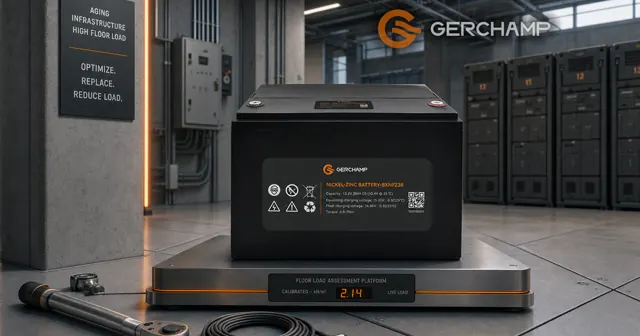
At equivalent capacity, the Gerchamp Nickel-Zinc battery (e.g. 8XNFZ38) weighs just 7.8kg. The equivalent VRLA battery weighs 28.5-33kg—Nickel-Zinc weighs only one-quarter as much. With the same 100-battery configuration, total weight drops from nearly 3 metric tons to under 800 kg.
This means the aging data center floor does not need reinforcement. Remove the VRLA batteries, install the Nickel-Zinc batteries—the load is reduced by more than two-thirds. The floor load compliance issue is resolved at the point of “which battery to choose,” rather than waiting for structural problems to emerge and then attempting remediation.
More importantly, Nickel-Zinc batteries have a design life exceeding 10 years, reducing replacement frequency from three or four times to just once over the same building lifecycle. Each replacement means less handling, less construction disturbance, and less additional floor loading.
Conclusion
VRLA replacement in aging data centers begins not with “which battery is cheaper,” but with “can this floor still bear the weight?”
For example, the Gerchamp Nickel-Zinc battery (8XNFZ38 13.2V, 38Ah) is a direct replacement for 110Ah 12V VRLA batteries—no cabinet replacement, no UPS system modifications required. With a 75% weight reduction, it transforms a structural compliance issue that might require hundreds of thousands in reinforcement costs into a procurement decision that is simply “install it and it’s done.” Beyound that, Gerchamp also offers 8XNFG90, a 90 Ah Nickel Zinc battery.
VRLA replacement is not just about battery performance upgrades—it is about subtracting weight from your floor load equation.
To learn more about VRLA replacement solutions and floor load compliance assessment, visit the Gerchamp website or contact our technical team.