

Data center UPS batteries are undergoing a quiet revolution. Lead‑acid batteries have dominated the backup power market for decades, but today lead‑acid replacement is increasingly seen as a smarter choice—whether measured by total cost of ownership (TCO), availability, or safety, nickel‑zinc (Ni‑Zn) batteries are emerging as an option that is hard to ignore.
The three burdens of lead‑acid
Lead‑acid batteries have three critical shortcomings.
First, short service life. VRLA lead‑acid batteries are typically designed to last only 3 to 5 years. Over a UPS system’s 15‑year lifespan, they often need to be replaced three or even four times. That means recurring capital expenditures, plus the risk of downtime and labour costs during each swap. The hidden costs of frequent replacements, on top of the initial purchase price, make the TCO of lead‑acid far less attractive than it appears on paper.
Second, large footprint. Lead‑acid has low energy density, so for the same power output it takes up far more space and weight than modern battery technologies. In a typical medium‑sized data center, the battery room often occupies hundreds of square metres just to house lead‑acid cabinets. In prime urban locations, that space could otherwise be used for IT racks generating direct revenue, or for additional GPU servers to support AI workloads.
Third, performance that lags behind modern demands. The explosion of AI workloads has made data center power consumption highly dynamic—GPU cluster loads can surge to several times their idle level in milliseconds. Lead‑acid’s low discharge rate simply cannot cope with such high‑frequency power shocks, risking voltage sags or even transfer failures during critical moments. At the same time, tightening carbon‑reduction targets and ESG compliance requirements are prompting more enterprises to rethink the sustainability of lead‑acid, given the heavy‑metal pollution issues throughout its production and recycling chain. These real‑world pressures have turned lead‑acid replacement from a theoretical concept into a concrete action for a growing number of data center operators.
Why nickel‑zinc is a superior lead‑acid replacement
Nickel‑zinc batteries are becoming the best answer to lead‑acid replacement. This is not a lab‑bound concept—it is a mature solution already validated in multiple data centers around the world.
Smaller footprint. Ni‑Zn batteries offer several times the power density of lead‑acid, while taking up only about half the volume and one‑third the weight for the same capacity. Battery room space can be reduced by more than 50%. For space‑constrained urban data centers, this means completing a lead‑acid replacement upgrade without expanding the room or reinforcing floor load‑bearing capacity, saving significant infrastructure investment.
Greater safety margin. Ni‑Zn uses a water‑based alkaline electrolyte that is non‑flammable, fundamentally eliminating thermal runaway risk. Even under extreme abuse tests—overcharge, short circuit, nail penetration, crushing—it does not explode or catch fire. The thermal‑runaway hazard of lithium‑ion batteries, by contrast, remains a sword of Damocles over data centers; once triggered, it can cause anything from service interruption to total loss.
Fewer replacements. Ni‑Zn batteries have a design life of up to 15 years and a cycle life several times that of lead‑acid. This means that over the entire lifespan of a UPS system, after completing lead‑acid replacement, the number of battery swaps drops from three or four to just one. The substantial reduction in maintenance costs and outage risks directly improves the TCO picture.
Better environmental profile. Over their full lifecycle, Ni‑Zn batteries show significantly lower carbon emissions compared to lead‑acid and lithium‑ion alternatives. They boast an extremely high recycling rate and contain no lead, cadmium, or rare‑earth elements, meeting international standards such as the EU Battery Regulation (2023/1542) and RoHS. For enterprises facing ESG compliance pressure, lead‑acid replacement is also an important step toward a greener data center.
Gerchamp’s practical lead‑acid replacement solution
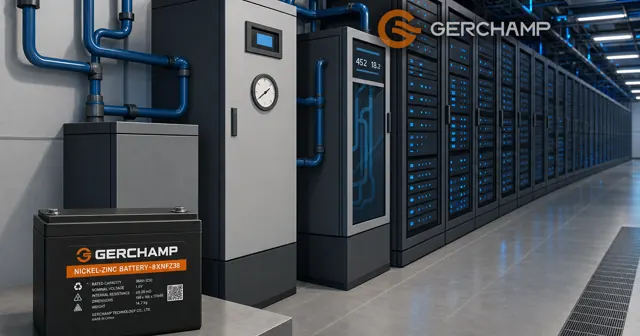
The Gerchamp nickel‑zinc battery (e.g. 8XNFZ38, 13.2V, 38Ah) is specifically designed for lead‑acid replacement:
Direct drop‑in replacement. It can directly replace a 110Ah 12V lead‑acid battery without changing the battery cabinet, redesigning the system, or modifying existing UPS rectifier parameters. From order to installation, the entire upgrade can be completed in as little as a few weeks, minimising disruption to business operations.
10C high‑rate discharge. It meets the millisecond‑level high‑current switching demands of UPS systems during grid fluctuations or load surges, making it especially suitable for the high‑frequency power impacts of GPU clusters in AIDC environments.
UL9540A certified and wide‑temperature operation. With zero thermal‑runaway risk, it operates stably from -20°C to 55°C, reducing reliance on air conditioning and indirectly improving PUE.
End‑to‑end in‑house R&D and manufacturing. Gerchamp controls the entire value chain—from electrochemistry and cell production to BMS and intelligent battery cabinets—providing a single point of responsibility and eliminating post‑sales finger‑pointing.
Gerchamp also offers other NiZn battery models, such as the 8XNFG90, to meet diverse UPS capacity and application requirements. Data center backup power upgrades are not simply about buying “more expensive batteries”—they are about choosing the right technology path for long‑term value. Lead‑acid replacement—swapping lead‑acid for nickel‑zinc—is becoming a consensus among more and more data center professionals.