

Introduction:
The modular data center market is experiencing explosive growth. The global modular data center market, valued at USD 34.84 billion in 2025, is projected to soar to USD 143.08 billion by 2034, representing a compound annual growth rate (CAGR) of 17.2%.
However, as modular data centers rapidly expand to edge sites, remote locations, and hyperscale campuses, a core issue emerges: what powers their backup systems? While the industry has paid enormous attention to modular cooling systems, modular racks, and modular IT infrastructure, the backup power source at the heart of the UPS system, battery technology, has surprisingly remained conventional. Most modular data centers still rely on traditional battery technologies that were never designed for the unique demands of modular, distributed infrastructure.
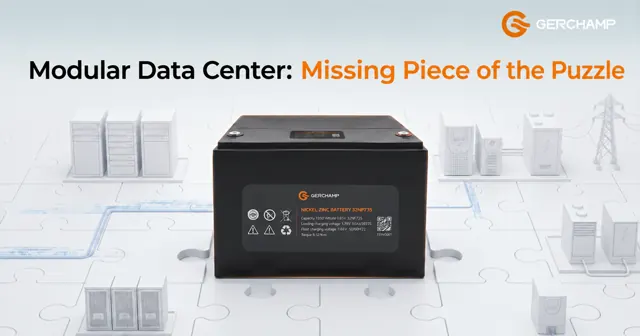
Enter the Nickel-Zinc (8XNFZ38) battery, a chemistry that may be the missing piece of the modular data center puzzle.
The Challenge: Power Requirements that Differ Fundamentally
Modular data centers have unique backup power needs that conventional battery chemistries struggle to address because:
-Space is extremely valuable. Whether deployed in a prefabricated enclosure or an edge cabinet, modular data centers have no room to spare. Every square foot must deliver value, ideally revenue-generating compute capacity. Backup batteries that consume too much floor space directly compete with IT equipment.
-Safety is non-negotiable. Many modular deployments operate in space-constrained, poorly ventilated, or mixed-use environments. A battery fire would be catastrophic. Traditional UPS batteries, especially lithium-ion, have inherent thermal runaway risks that are magnified inside enclosed modular enclosures.
-Temperature tolerance. Remote edge sites are often located in regions with poor environmental conditions and cannot support precise climate control. The electrical equipment, especially backup batteries that serve as the last line of defense, must perform reliably under extreme temperatures.
Why Nickel-Zinc Batteries Are the Ideal Choice for Modular Data Centers
1. High Power Density: More Performance in a Smaller Footprint
Nickel-Zinc batteries offer up to three times the power density of traditional lead-acid batteries, at only one‑third the weight and half the volume. This smaller, lighter form factor simplifies installation, reduces structural requirements, and allows modular data center operators to free up valuable space for revenue‑generating equipment.
Nickel-Zinc’s industry‑leading power density means you can either pack more backup capacity into the same physical enclosure or shrink your battery footprint to make room for additional server racks.
2. Intrinsic Safety: No Thermal Runaway Risk
Perhaps the most significant advantage of Nickel-Zinc batteries for modular data center applications is their inherent safety.
Nickel-Zinc batteries use a water‑based (aqueous) alkaline electrolyte that is non‑flammable. Unlike lithium‑ion batteries that use flammable organic solvents as electrolytes, Nickel-Zinc systems present no fire risk. The positive electrode material does not release oxygen under extreme conditions, eliminating the fuel source needed for thermal runaway.
This fundamentally changes the facility’s risk profile. In a modular enclosure, where space is tight, ventilation may be limited, and fire suppression systems are difficult to integrate. A battery chemistry that simply does not catch fire offers enormous operational advantages. Nickel-Zinc systems eliminate the need for expensive fire suppression equipment, more easily comply with fire codes, and avoid the policy restrictions that are increasingly limiting lithium‑ion batteries in certain environments.
Even under extreme conditions such as overcharge, short circuit, or physical damage, Nickel-Zinc batteries remain stable. Their response is gradual degradation, not sudden fire.
3. Wide Operating Temperature Range: Deploy Anywhere
Modular data centers operate in environments that lack the sophisticated climate control of traditional facilities. Nickel-Zinc batteries are exceptionally well‑suited to these conditions.
Nickel-Zinc batteries operate reliably from -20°C to +55°C, making them ideal for environments without climate control, such as remote areas. At an extreme low temperature of -20°C, Nickel-Zinc batteries retain over 80% of their rated capacity and maintain high‑current discharge capability, whereas lead‑acid batteries lose more than half their capacity and struggle to deliver effective power output.
This wide operating range reduces or eliminates the need for dedicated battery climate control systems, simplifying modular design and lowering total cost of ownership.
Conclusion:
Not all battery chemistries are suited for the same application. Nickel-Zinc batteries are not designed to compete directly with lithium‑ion in every energy storage application. Instead, they precisely target areas where safety, response speed, and operational reliability are most critical, such as modular data centers, industrial campuses, and critical edge infrastructure.
In modular data center solutions where space is constrained, environments vary, and safety requirements are stringent, Nickel-Zinc demonstrates comprehensive advantages that traditional chemistries cannot match: high power density in a compact form factor, inherent thermal stability, and a wide operating temperature range.
As the modular data center market continues to grow rapidly, from edge deployments to hyperscale prefabricated facilities, the choice of backup battery chemistry will increasingly become a key factor that distinguishes optimized, future‑ready solutions from those that merely perpetuate traditional compromises.
For operators planning next‑generation modular data center infrastructure, Nickel-Zinc batteries deserve close attention. They may just be the critical missing piece of the technology puzzle.
FAQ
Q1: What is the core advantage of Gerchamp Nickel-Zinc batteries in modular data centers?
The core advantage is intrinsic safety. Gerchamp Nickel-Zinc batteries use a water-based alkaline electrolyte that is non-flammable, and the positive electrode material does not release oxygen under extreme conditions—breaking the complete chain of thermal runaway at the chemical level. They are UL9540A certified and have passed abuse tests including short circuit, nail penetration, and direct fire exposure with zero fire and zero explosion.
Q2: With limited space in modular deployments, how do Gerchamp Nickel-Zinc batteries perform in terms of size and weight?
The Gerchamp 8XNFZ38 weighs just 7.8kg per unit, compared to 23–26kg for an equivalent lead-acid battery, and its volume is approximately half that of lead-acid. The lighter, more compact design simplifies transportation, installation, and structural load requirements—offering distinct advantages in the logistics and installation phases of modular deployment.
Q3: Can Gerchamp Nickel-Zinc batteries operate reliably in harsh edge site environments?
Yes. Their operating temperature range is -20°C to +55°C. Even at the extreme low of -20°C, they retain over 80% of rated capacity while maintaining high-current discharge capability. No dedicated battery climate control system is required, greatly simplifying facility design for edge sites.
Q4: Can Gerchamp Nickel-Zinc batteries integrate with existing monitoring systems in modular data centers?
Yes. Gerchamp Nickel-Zinc battery cabinets come equipped with a BMS that supports standard protocols such as RS485, MODBUS, and SNMP, enabling direct integration with existing DCIM or UPS monitoring platforms for remote SOC and SOH status visibility. Gerchamp provides an end-to-end, full-stack in-house solution—from cell chemistry and BMS to full cabinet integration.