

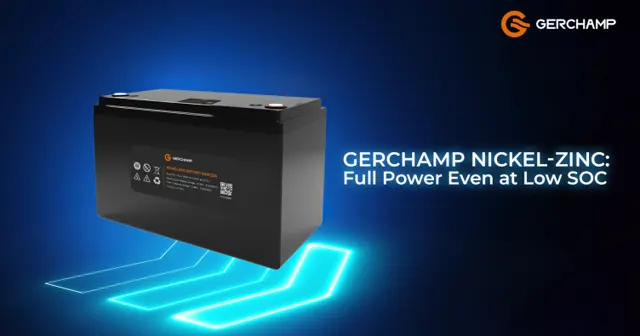
AI data centers (AIDCs) are undergoing a quiet power revolution. As the power density and instantaneous fluctuation magnitude of GPU clusters continue to rise, traditional backup battery solutions are beginning to show their limitations. Today, we want to share with you a technical feature that is often overlooked yet critically important: Even at a low state of charge (SOC), Gerchamp batteries retain usable energy and deliver maximum power output. What does this feature truly mean for AIDCs and high-density computing environments?
The “Power Heartbeat” of GPU Clusters
To understand this, we must first look at the power characteristics of AI workloads. Unlike ordinary enterprise IT equipment, large-scale GPU clusters, when executing parallel training or burst inference tasks, generate severe and high-frequency power fluctuations:
Microsecond-scale spikes: Certain synchronized instructions (e.g., the EDPp2 spike) can surge the current to twice the full load within 40 microseconds, lasting only a few hundred microseconds.
Second-to-minute sustained high loads: During model loading or checkpoint saving, power consumption may suddenly rise and remain elevated for dozens of seconds.
Conventional backup batteries (such as valve-regulated lead-acid or standard lithium-ion) often fail to simultaneously deliver high power output and voltage stability when at a low SOC. To cope with these transient gaps, operations teams are forced to resort to “over-provisioning” — installing far more capacity than actually needed for backup energy, just to ensure sufficient power delivery capability during emergencies. This not only wastes valuable rack space but also drives up total cost of ownership (TCO).
Gerchamp Batteries: Full Power at Low SOC
Gerchamp 8XNFZ38 adopts an aqueous electrochemical system. One of its core characteristics is a wide SOC range over which internal resistance remains stable. This means:
No need for over-provisioning: You can size the battery capacity based on real backup energy requirements, not power requirements. Even if the battery sits at a low SOC after daily shallow cycling or partial discharge, it can still instantly deliver the same maximum power as when fully charged, should a power outage or power spike occur.
Significantly higher usable energy: To reserve enough power output capability, conventional batteries often lock away the bottom 20%-30% of their SOC range. Gerchamp batteries unlock this “captive” energy, allowing the same physical capacity to support longer backup times.
Three Core Advantages in AIDCs
1. Lower TCO and freed-up space
Take a 10 MW AIDC as an example. To cope with GPU instantaneous power spikes, a conventional battery system would require an additional 30% capacity as a power buffer. Gerchamp batteries completely eliminate this redundancy, reducing the number of cabinets and freeing up space to install more GPU servers.
2. Enhanced power resilience
During the critical 5-to-30-second transition window between a complete utility outage and diesel generator startup, if the battery happens to be at a low SOC (e.g., after a previous minor grid fluctuation has consumed part of its charge), conventional batteries may fail to support the load due to power degradation. Gerchamp batteries eliminate this risk, providing the system with a truly reliable “last line of defense.”
3. Simplified maintenance and extended lifespan
Stable output at low SOC means you no longer need to frequently perform full-charge equalization or health tests on the battery. Gerchamp batteries are designed with a lifespan far exceeding that of traditional lead-acid batteries. Combined with a high-precision BMS (SOC/SOH estimation error <5%), they enable truly low-maintenance operation.
Closing Thoughts
In the next phase of the AI computing race, the intelligence and resilience of power infrastructure will be just as important as compute density. The “low SOC, high power” characteristic of Gerchamp batteries precisely targets the most vulnerable link in GPU cluster power delivery. It makes over-provisioning a thing of the past, and puts every ampere-hour of battery capacity to its fullest use.
FAQ
Q1: Why do GPU cluster power fluctuations pose a challenge to conventional backup batteries?
Conventional batteries experience significant power degradation at low SOC. To cope with millisecond-level GPU power spikes, operations teams are forced to over-provision more than 30% extra capacity as a power buffer, resulting in wasted resources.
Q2: Why can Gerchamp nickel zinc batteries maintain full power output even at low SOC?
The core lies in the aqueous electrochemical system, which keeps internal resistance stable across a wide SOC range (≤5mΩ). Low internal resistance means minimal voltage sag regardless of SOC level, delivering consistent transient high-current output.
Q3: How do Gerchamp nickel zinc batteries help reduce TCO in AIDCs?
In a 10MW AIDC, conventional solutions require an extra 30% capacity as a power buffer. Gerchamp batteries eliminate this redundancy—fewer cabinets, smaller footprint, and freed-up space for additional GPU servers.
Q4: What high-rate discharge capabilities and BMS functions do Gerchamp nickel zinc batteries offer?
Supports continuous 10C high-rate discharge with 380A maximum discharge current. BMS monitors voltage, internal resistance, and temperature per cell in real time, with SOC/SOH estimation error <5%, and supports RS485, MODBUS, and SNMP protocols for direct integration with existing DCIM platforms.