

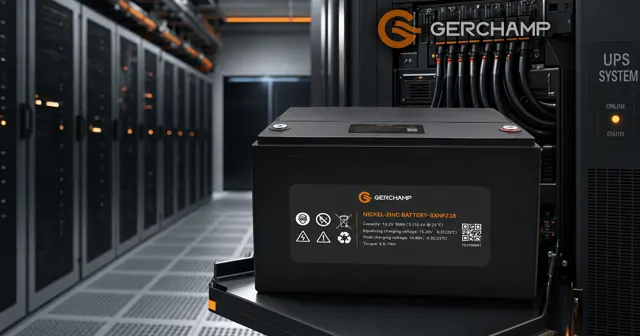
A UPS system typically consists of three parts: rectifier, inverter, and battery bank. The choice of battery bank directly affects backup time and operational costs.
Nickel-zinc (NiZn) batteries belong to the alkaline rechargeable battery family. As an emerging chemical power source, they are playing an increasingly important role in various UPS systems – providing backup power for critical loads.
Data Centers: Freeing Up More Space for Servers
Traditional lead-acid batteries in data centers are bulky and tend to have shorter lifetimes at high temperatures, while some lithium-ion solutions demand complex management systems. Gerchamp nickel-zinc batteries offer different advantages: they have higher energy density than ordinary lead-acid batteries and take up only 1/2 to 1/3 of the volume – saving valuable floor space for higher-value IT equipment, with no thermal runaway risk.
Medical Facilities: Increasing Backup Power Reserve for Critical Equipment
Operating rooms, ICUs, and mobile medical devices require nearly undetectable UPS transfer times. A practical feature of nickel-zinc batteries is that they maintain stable performance under long-term float charging and can still deliver full power output even at low state of charge.
Gerchamp nickel-zinc batteries (e.g. 8XNFZ38) are inherently safe. Thanks to their water-based electrolyte and chemically stable terminal design, they have no thermal runaway risk. The UL9540A certification further confirms the safety of Gerchamp nickel-zinc batteries. In addition, because the nickel-zinc chemistry contains no mercury or cadmium, spent batteries are easier to sort and recycle, aligning with the green procurement trends of healthcare institutions. Gerchamp offers a range of NiZn battery models for different UPS applications, including the 8XNFG90 alongside the 8XNFZ38.
Financial Institutions: Enhancing Power Stability for Trading Systems
The UPS systems in bank data centers and securities trading platforms must cope with frequent grid fluctuations. Gerchamp nickel-zinc batteries provide a relatively flat discharge voltage platform, helping to narrow the inverter’s adjustment range and thus extend UPS service life.
When the grid voltage sags, Gerchamp nickel-zinc batteries immediately release energy – with 10C discharge capability supporting momentary high current surges. In actual power outages, UPS units equipped with nickel-zinc batteries have maintained uninterrupted output, giving maintenance personnel more time to respond and avoiding substantial losses caused by blackouts.
Telecom Base Stations: Superior Temperature Adaptability
Nickel-zinc batteries offer excellent temperature adaptability, maintaining a strong discharge curve under harsh low‑ or high‑temperature conditions. This makes them an ideal choice for backup batteries in edge communication base stations located in challenging environments or regions. Compared with traditional backup batteries, lead-acid batteries tend to dry out at high temperatures, leading to increased internal resistance, heat buildup, and eventual thermal runaway. For lithium-ion batteries, thermal runaway at high temperatures can instantly reach over 200°C – and losses caused by lithium‑ion thermal runaway in recent years have been significant.
Summary
Overall, as a backup energy component for UPS systems, nickel-zinc batteries show considerable replacement potential across multiple industries: they are lighter and more reliable than lead-acid batteries, and safer than lithium-ion systems. With proper selection and matching charge parameters, nickel zinc battery cabinets can help users in data centers, hospitals, financial institutions, and beyond achieve more stable backup power experiences.