

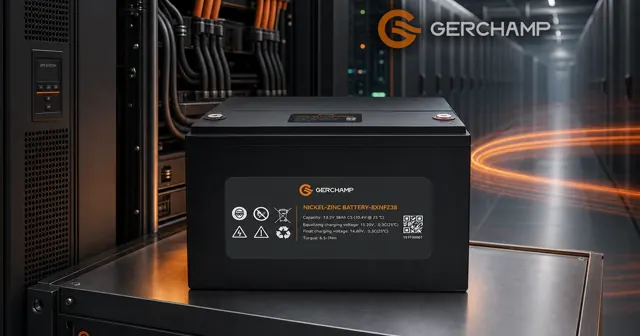
As demand for reliable backup power continues to grow, battery technology is becoming increasingly critical for modern critical infrastructure.
Data centres, AI computing facilities, telecommunications networks and industrial systems require backup batteries that not only provide reliable energy storage, but also deliver fast response, high power output, safety and long-term operational stability.
Nickel-zinc battery technology, as an advanced battery solution, combines high power performance, intrinsic safety characteristics and environmental advantages.
This guide, together with the Gerchamp Nickel Zinc Battery (8XNFZ38 and 8XNFG90), explains what a nickel-zinc battery is, how it works, why this technology is gaining attention and how it supports modern UPS and critical infrastructure applications.
What Is a Nickel Zinc Battery?
A nickel-zinc battery is a rechargeable battery technology that uses a nickel-based positive electrode, a zinc-based negative electrode and an alkaline electrolyte system to store and release electrical energy.
The chemical combination of nickel and zinc achieves a good balance between power capability, safety and operational reliability, enabling nickel-zinc batteries to meet the backup power performance requirements of modern critical infrastructure.
Compared with traditional lead-acid batteries, Gerchamp nickel-zinc batteries offer clear advantages in power performance, charge capability and operational flexibility, providing a new technology option for critical backup power applications such as UPS.
Compared with lithium-based batteries, Gerchamp nickel-zinc batteries use an aqueous alkaline chemistry, offering a different technological path that maintains reliable performance while delivering excellent safety characteristics.
How Does a Nickel Zinc Battery Work?
Like other rechargeable batteries, Gerchamp nickel-zinc batteries store and release energy through reversible electrochemical reactions.
During charging, externally applied electrical energy drives electrochemical reactions inside the battery, converting electrical energy into chemical energy for storage.
During discharging, the stored chemical energy is converted back into electrical energy, providing a stable power output to the UPS system or other critical equipment.
The synergy between the nickel-based positive electrode, zinc-based negative electrode and alkaline electrolyte determines the battery’s charge acceptance, discharge capability, energy conversion efficiency and long-term operational stability.
For critical backup power applications such as UPS, this electrochemical system enables the battery to release energy quickly during grid interruptions or load transients, achieving reliable transient response.
The Gerchamp 8XNFZ38 Nickel Zinc Battery and 8XNFG90 Nickel Zinc Battery are representative products of this technology in UPS and critical power applications, achieving high power output, fast response and reliable operation through optimised battery design.
Why Is Nickel Zinc Battery Gaining Attention?
The rapid growth of AI workloads and high-density data centres presents new challenges to backup power systems.
Modern critical infrastructure requires battery technologies such as the Gerchamp Nickel Zinc Battery, which is why the question “Why Is Nickel Zinc Battery Gaining Attention” matters: they can provide:
-
Faster power response that can complete load transfers in milliseconds
-
Higher power density that frees up valuable floor space and floor load capacity
-
No thermal runaway, which minimises data centre operational risk
-
Much more durable chemistry for a wider temperature range
-
No single point of failure, with stable and reliable performance throughout the entire battery lifecycle
-
Lower total cost of ownership, with lower maintenance and replacement needs
Nickel Zinc Battery vs Other Battery Technology
Different UPS battery technologies have their own advantages depending on application needs. For critical power applications, key evaluation factors include safety, charge capability, power performance, lifecycle performance and environmental impact.
Compared with lead-acid batteries, lithium-based batteries and other zinc battery technologies, Ni Zinc Battery uses a different electrochemical system that provides its own balance of power performance, safety, operating temperature and lifecycle characteristics.
For data centre operators, understanding this comparison is increasingly important. Each technology offers distinct trade-offs, but the choice directly affects critical operational outcomes: how much battery space is needed, how well the system responds to AI-driven load fluctuations, what safety measures are required and what the long-term cost profile looks like. As data centre infrastructure becomes more power-dense and dynamic, the technology decision extends beyond the battery room to shape broader facility planning, risk management and sustainability performance.
What Design Principles Enable High Performance in Nickel Zinc Battery?
Multiple key factors in nickel-zinc battery design determine its performance, including material systems, electrochemical reactions, electrolyte design, internal resistance control and battery management technology.
A truly excellent backup battery achieves perfect synergy among these factors through design, as these factors directly affect important battery characteristics such as charge speed, power output, efficiency and long-term reliability.
Applications of Nickel-Zinc Battery
Nickel-zinc battery applications are primarily found in backup power and other critical infrastructure, where high power output, fast response, safety and reliable long-term operation are essential. Their combination of high-rate discharge capability, aqueous alkaline chemistry, wide operating temperature range and stable performance makes them well suited to scenarios that demand dependable power during grid interruptions, transient events or other power disturbances.
Today, nickel-zinc battery technology is being applied across:
- UPS Systems
- AI Data Centres
- Telecommunications Infrastructure
- Financial Industry Infrastructure
- Rail Transit and Critical Infrastructure
As the requirements of different industries vary in terms of power, runtime, environmental conditions, safety and deployment space, Gerchamp nickel-zinc battery systems can be designed and configured according to the specific requirements of each application.
Nickel Zinc Battery for Future Backup Power
Gerchamp nickel-zinc battery technology represents a new generation of backup power solutions that integrate performance, safety and reliability.
As critical infrastructure continues to evolve, battery systems must provide more than just backup power. They must also deliver fast response, stable operation, efficient recovery and safe deployment.
With its unique chemistry and ongoing material innovations, nickel-zinc battery technology is becoming an increasingly important solution for modern UPS and critical power applications.
Gerchamp’s nickel-zinc battery technology is fully designed and manufactured in-house, offering cell-to-cabinet solutions.
Frequently Asked Questions (FAQ)
Is the Gerchamp nickel zinc battery better for UPS systems than lead-acid batteries?
It depends on the specific application requirements.
For traditional UPS applications, lead-acid batteries remain a mature and widely used solution. However, as AI data centres, high-density computing and critical infrastructure evolve, more UPS systems are focusing on power response, safety, space utilisation and maintenance costs.
In these scenarios, Gerchamp nickel-zinc batteries, with their low internal resistance, high-rate discharge capability and enhanced safety, offer a new technology option for modern UPS systems.
Is the Gerchamp nickel zinc battery safe?
Gerchamp nickel-zinc batteries use an aqueous alkaline electrolyte rather than a flammable organic electrolyte, which gives them different safety characteristics from some lithium-based batteries.
Gerchamp Nickel Zinc Battery, with its aqueous alkaline chemistry, did not experience thermal runaway under UL9540A test conditions. This material system reduces safety risks in critical infrastructure, which is why it is gaining attention from data centres and UPS applications.
What is the service life of a Gerchamp nickel zinc battery?
Battery life is affected by many factors, including depth of discharge, operating temperature, operating environment and maintenance practices, so it may vary between applications.
For critical backup power applications such as UPS, under reasonable system design and normal operating conditions, the Gerchamp Nickel Zinc Battery has a design life of up to 15 years.
Can nickel zinc batteries replace lead acid batteries?
In many UPS and critical backup power applications, Gerchamp nickel-zinc batteries can serve as an alternative to lead-acid batteries.
For applications seeking improved power performance, safety and long-term reliability, nickel-zinc batteries are becoming an increasingly attractive choice.
Which industries mainly use Gerchamp nickel zinc battery?
Nickel-zinc batteries are suitable for critical infrastructure requiring highly reliable backup power, including:
- UPS systems
- AI data centres
- Telecommunications infrastructure
- Financial industry infrastructure
- Rail transit
- Industrial critical facilities As requirements for backup power reliability, safety and response speed continue to rise, nickel-zinc batteries are being adopted by more mission-critical applications.
Why is internal resistance so important for UPS backup batteries?
When a UPS switches from mains to backup power, the battery must deliver current within a very short time.
Lower internal resistance reduces voltage drop and energy loss during discharge, giving the UPS a more stable output voltage and improving the system’s ability to respond to transient load changes. Therefore, internal resistance has become an important design metric for modern UPS backup batteries.
Why do modern UPS systems pay more attention to battery design rather than just capacity?
In the past, UPS backup batteries were typically evaluated mainly by capacity, because capacity determined how long the system could sustain backup power.
Today, modern UPS systems focus not only on runtime but also on power output capability, response speed, safety, maintenance requirements and long-term reliability. As a result, battery design has evolved from merely affecting energy storage capacity to directly influencing the overall performance of the UPS system.
What nickel zinc battery solutions does Gerchamp offer?
Gerchamp offers nickel-zinc battery solutions for UPS and critical power applications, including individual nickel-zinc cells and battery cabinet systems built with these cells.
Among them, the Gerchamp 8XNFZ38 Nickel Zinc Battery and Gerchamp 8XNFG90 Nickel Zinc Battery are nickel-zinc products for different backup power needs, selectable according to system capacity, runtime and deployment requirements.
On this basis, Gerchamp further provides integrated nickel-zinc battery cabinet solutions that combine cells, a battery management system (BMS) and system-level design, delivering more efficient and reliable UPS backup power solutions for data centres and critical infrastructure.