

With artificial intelligence, high-performance computing, and cloud services growing quickly, data centres around the world are changing.
They are entering a new phase. On the one hand, new data centres are being built continuously; on the other, a large number of facilities that have been operating for many years are now facing ageing infrastructure.
According to industry research, the average age of data centre facilities worldwide is about 11 years, and roughly half of all facilities have been in operation for more than 10 years, gradually approaching their original design life. Although these facilities still carry significant IT loads, a long‑neglected issue is becoming increasingly apparent:
While core data centre equipment continues to evolve, UPS battery systems have remained stuck in the past.
Data centres keep upgrading, but battery technology lags behind
Over the past decade, nearly every critical infrastructure component in data centres has undergone rapid development.
Server architectures have been continuously upgraded to support higher computing performance and power density; cooling systems have been optimised to tackle the thermal challenges posed by AI and high‑density computing; and UPS equipment itself has evolved from traditional topologies towards higher efficiency, greater modularity, and smarter management.
Yet, in many data centres, the battery rooms are still filled with conventional VRLA (Valve‑Regulated Lead‑Acid) solutions.
Undeniably, VRLA battery technology has seen steady improvements over the decades—better materials, refined manufacturing processes, and enhanced reliability. However, these advances are mostly incremental optimisations, not fundamental changes in the underlying technology path.
UPS battery replacement should not be just a repetitive procurement exercise
Today, most data centres still treat UPS battery replacement as a routine maintenance task.
Typically, VRLA batteries are replaced every three to five years: the old units are removed, new ones installed, and operations resume. Lead‑acid replaced by lead‑acid—essentially “new for old” in the same technology.
In the past, data centre operators were not unwilling to upgrade; rather, there has been a long‑standing lack of viable alternatives that could simultaneously address safety, reliability, compatibility, and cost.
But as more and more data centres enter their second or even third lifecycle phase, the upcoming battery replacement cycle is becoming a critical window to re‑evaluate the infrastructure.
New challenges for ageing data centres: space, floor loading, and safety
One of the biggest differences between ageing data centres and new builds is that the physical infrastructure is already fixed. As equipment continues to accumulate, many older facilities are facing:
-
Limited room space
-
Floor loading capacity constraints
-
Increasing cooling pressure
-
Higher operational and maintenance costs
-
Stricter safety requirements
In the past, battery selection focused mainly on capacity and cost. Today, as data centres scale up and the value of mission‑critical operations rises, backup power systems are shifting from merely meeting power demands to enabling broader infrastructure optimisation.
Nickel‑zinc batteries: a new option for upgrading legacy data centres
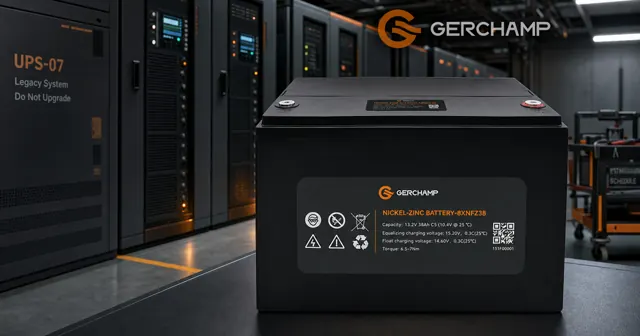
As data centres enter a new lifecycle phase, Gerchamp’s nickel‑zinc battery technology (8XNFZ38, 8XNFG90) offers a fresh alternative for UPS backup power upgrades.
Compared to traditional VRLA solutions, nickel‑zinc batteries deliver advantages in several key areas that align with the needs of modern data centres.
First, nickel‑zinc batteries offer higher power performance and significantly lower system weight. At the same capacity, a lighter battery system can ease the burden on floor loading and installation space in ageing data centres—meaning operators can achieve battery system optimisation without major facility modifications.
Second, nickel‑zinc batteries use an aqueous alkaline electrolyte and do not rely on the flammable organic electrolytes found in lithium‑ion systems, giving them a higher inherent safety profile.
As data centre safety standards and risk management requirements continue to rise, battery safety is becoming a decisive factor in future backup power choices.
Moreover, a longer design life translates into fewer replacement cycles, less maintenance pressure, and more stable long‑term operation.
The next UPS battery replacement could be an infrastructure upgrade opportunity
Older data centres do not necessarily require a complete rebuild. Sometimes, the most effective upgrades come from those long‑overlooked basic components—and UPS batteries are one of them.
When the next battery replacement cycle arrives, data centre operators should be asking not just: “Which batteries should we buy?” but rather: “Should we keep replicating the same solution we’ve used for decades?”