

Introduction
Backup batteries for data center UPS units, telecom base stations, and substation DC panels normally sit silently in float charge. When a mains failure occurs, they must instantly support the entire load. However, most backup batteries spend their lives in long‑term idle storage, and early‑stage faults show almost no external signs. By the time manual inspections detect a hot casing, abnormal voltage or capacity loss, the battery has often already entered irreversible degradation or even thermal runaway.
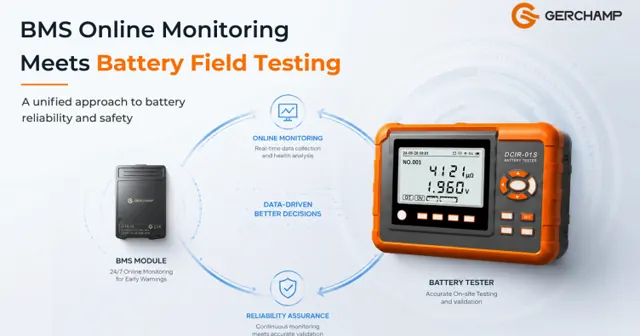
Effective battery management requires two core capabilities: continuous visibility (real‑time insight into changing battery health) and accurate on‑site verification (precise diagnosis of suspect cells). Continuous visibility is the core value of an online BMS; on‑site verification can be performed by supplementary test instruments. The two work together as a complete solution.
Three Common Failure Modes of Lead‑Acid Backup Batteries
In large data centers, telecom base stations and similar sites, valve‑regulated lead‑acid (VRLA) batteries are still widely used. The three most typical failure modes are:
(A) Water Loss
Symptoms: casing becomes abnormally hot during charging; charger stays in “charging” state for a long time without turning green; voltage drops briefly after a water refill.
Hazards: exposed plates impair electrochemical reactions; continuous high temperature can trigger thermal runaway; accumulated hydrogen gas poses an explosion risk.
(B) Sulfation
Symptoms: charger shows “fully charged” very quickly; voltage drops rapidly under load; internal resistance rises significantly.
Hazards: hard lead sulfate crystals block the micropores of active material, causing capacity to decline year by year. The terminal voltage may appear normal, making it very difficult to detect during manual inspections.
(C) Internal Short Circuit
Symptoms: terminal voltage is markedly lower than other batteries in the same string; localized heating during charging; voltage fails to rise normally, and capacity is extremely low.
Hazards: the shorted battery continuously drains energy from the whole string, dragging down the entire battery bank. During discharge, it may heat up in reverse and cause a fire.
Value and Objective Limitations of Manual Inspections
Manual inspections using professional test instruments (e.g. internal resistance testers, voltmeters) are the most basic and widespread backup battery maintenance method. They effectively find persistent, overt faults, such as severely lagging cells, leakage, and casing deformation and are the first line of defense for battery safety.
At the same time, it must be recognized that manual inspections are intermittent (typically monthly or quarterly), leaving blind windows between visits. Battery faults do not always develop slowly; a micro‑short can arise in tens of minutes, and thermal runaway can escalate in just tens of minutes. Moreover, inspection intervals at unattended sites (e.g. remote base stations) are even longer, so that by the time a fault is discovered, it is often already severe. Therefore, relying solely on scheduled inspections makes it difficult to fully cover rapidly developing thermal risks and gradually accumulating aging trends.
Online BMS Provides Continuous Visibility
With continuous data, the Gerchamp G‑TH can automatically assess battery health. It identifies thermal runaway risks early. At the same time, it uses Kalman filtering and a fuzzy neural network algorithm to deliver high‑accuracy SOC (State of Charge) and SOH (State of Health) estimation, with an accuracy of ±5%.
When any parameter shows an abnormal trend (e.g. persistently rising internal resistance, temperature out of normal range, voltage imbalance), the system instantly flags the condition and generates an alarm. Maintenance personnel no longer need to wait for a monthly or quarterly inspection, they receive an early warning at the embryonic stage of a fault, allowing ample time to schedule on‑site checks and maintenance.
On‑Site Verification: A Beneficial Complement by Test Instruments
After the online BMS identifies a suspect battery, maintenance personnel need to perform on‑site verification to determine the exact type of fault (water loss, sulfation, or short circuit) and decide on a repair plan. A high‑accuracy battery tester (such as the Gerchamp DCIR‑01S) can then provide precise on‑site verification.
Conclusion
For backup power in critical loads such as data centers, telecom base stations, and substations, relying solely on scheduled inspections cannot fully address rapidly developing thermal risks and gradually accumulating aging problems.
An online BMS (such as the Gerchamp G‑TH) provides the indispensable continuous visibility – 24/7 tracking of voltage, internal resistance, temperature, and current to give proactive warning at the earliest stage of a fault. At the same time, combining it with a high‑accuracy battery tester for on‑site verification creates a complete operation and maintenance loop.
Upgrading battery management from “periodic check‑ups” to “round‑the‑clock cardiac monitoring + precise outpatient review” is the optimal path to ensure backup battery reliability, reduce downtime risk, and extend equipment service life. At the heart of this upgrade is the continuous, intelligent, forward‑looking health management capability provided by the BMS.