

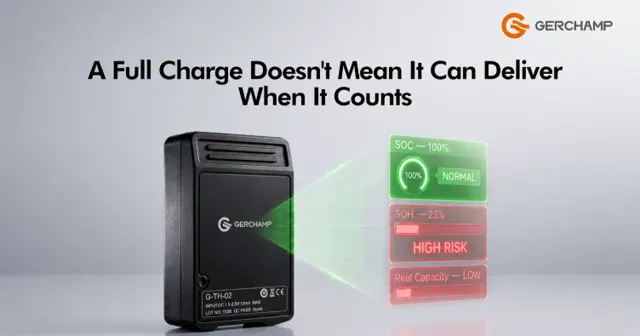
Imagine this: at 2:00 AM, a utility power fluctuation triggers your UPS to switch to battery backup. The monitoring panel shows 95% SOC, everything appears normal. But the next second, the rack goes dark, and business comes to a halt.
SOC ≠ SOH
SOC (State of Charge) measures how much energy is left in the battery; it’s a pure percentage concept.
SOH (State of Health) measures whether the battery can still perform as expected; it reflects the performance level of an aged battery relative to when it was new.
An aging, degraded lead-acid battery may display a healthy 95% SOC, but its internal resistance may have already doubled, and its actual usable capacity dropped to just 60% of its rated value. Under float-charge conditions, everything looks fine. But once a real discharge event occurs, voltage plummets instantly, the moment the UPS transfers to battery becomes the moment of power loss.
Key factors affecting SOH include internal resistance, temperature, and charge/discharge behavior. Internal resistance, in particular, is directly correlated with SOH, as batteries age, lose water, and suffer from plate sulfation, their internal resistance gradually increases. This rise is the most reliable early warning signal.
From Guesstimating to Data-Driven
For years, battery monitoring has relied heavily on manual inspections. But this approach is not only inefficient, it also struggles to provide real-time visibility into battery operating conditions. In a typical data center server room, routine inspections can take 4–6 hours per day, covering dozens of equipment categories including power distribution, cooling, and environmental systems, with batteries being just one item on the checklist. The timeliness, frequency, and accuracy of manual checks are simply insufficient to capture the gradual creep of internal resistance. Incomplete inspections or subjective misjudgments are also difficult to avoid entirely.
A true picture of battery health must draw on three dimensions of data:
Internal resistance trend analysis–for VRLA batteries, an internal resistance increase of 20%–25% above the baseline value is the most reliable early indicator of SOH degradation;
Discharge curve analysis–simulating whether actual capacity meets requirements under power-loss conditions, and whether voltage drop rates are abnormal;
Multi-cycle historical data–behavioral changes after repeated shallow discharge cycles, along with temperature characteristics.
This is why online monitoring should serve as the primary pillar of battery status awareness. Through 24/7 continuous data acquisition and trend tracking, it can detect early signs of internal resistance rise and capacity fade as soon as they emerge. Manual inspections, in turn, serve as a valuable complement, focusing on visual checks, terminal connection verification, and ambient temperature/humidity validation that online systems cannot easily cover. Together, the two approaches form a complete battery health management framework.
The Gerchamp G-TH Battery Management System delivers data- and algorithm-driven answers with certainty:
- ±5% accuracy for both SOC and SOH, far exceeding conventional lead-acid BMS capabilities
- Kalman filtering algorithms that track real-time internal battery states and identify early aging signatures
G-TH doesn’t rely on the “feel” of intermittent human patrols. Instead, it leverages continuous data sampling and intelligent model-driven analytics to produce quantifiable SOH trend reports, issuing early warnings before cell health deteriorates to a critical point.
Proactive Detection, Not Passive Failure Response
The ultimate goal of intelligent backup power management is to shift operations from a reactive model to a data-driven, predictive maintenance approach featuring proactive alerts. By continuously monitoring internal resistance trends, discharge curves, and SOH evolution, the system can issue warnings before battery performance degrades past critical thresholds, buying operations teams a window for scheduled replacement, rather than forcing them to confront battery failure and unplanned downtime in the middle of a grid disturbance.
Enterprises that adopt BMS and predictive maintenance strategies are transforming battery failures from an emergency disaster into a scheduled maintenance item. Of course, all of this presupposes that your BMS itself is reliable enough to trust.
FAQ
Q1: How does G-TH BMS distinguish normal SOH degradation from abnormal aging?
Through multi-cycle historical data analysis—tracking internal resistance change rates and capacity recovery curves after each charge/discharge cycle. Normal degradation shows gradual linear increase, while abnormal aging appears as step-change jumps or sharp drops in capacity recovery rate, with algorithms automatically flagging the deviation.
Q2: What is the SOC/SOH estimation accuracy of G-TH BMS and how does it compare to conventional BMS?
The G-TH BMS delivers ±5% accuracy for both SOC and SOH, compared to ±10%-15% for conventional lead-acid BMS. The difference comes from G-TH’s dual-calibration mechanism combining Kalman filtering with internal resistance correction, rather than relying solely on voltage look-up tables.
Q3: What communication protocols and sampling frequency does G-TH BMS support?
Supports RS485, MODBUS, and SNMP protocols for direct integration with DCIM or existing monitoring platforms. Data sampling is continuous at second-level intervals, with internal resistance trend data updated hourly to ensure no early aging signals are missed.
Q4: What is the internal resistance measurement accuracy of Gerchamp G-TH BMS and what algorithm does it use?
The G-TH BMS delivers ±2% repeat accuracy for internal resistance measurement, with a measurement range of 50 to 65,535 μΩ and a resolution of 1 μΩ. The algorithm combines online parameter identification with Kalman filtering and fuzzy neural network algorithms