Telecommunications Battery Monitoring

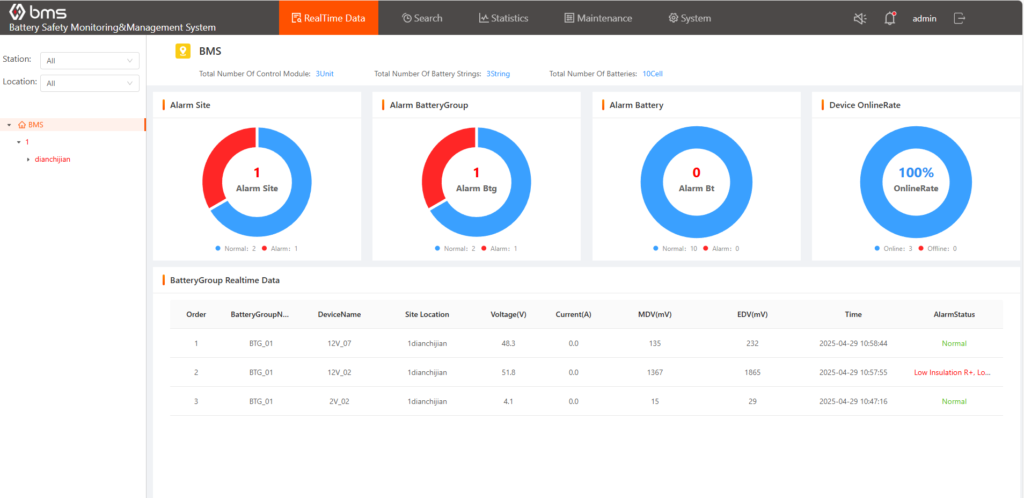
Telecommunications Battery Monitoring To achieve truly effective telecom battery monitoring, operation and maintenance engineers must build a round-the-clock automated battery monitoring system (BMS). The core of this system must monitor three key indicators: internal resistance (IR), monomer voltage and temperature. Whether it is the traditional lead-acid battery or the current lithium iron phosphate (LiFePO4), through the central gateway to summarize the battery pack data, we can accurately calculate the battery’s state of health (SOH) and state of charge (SOC). This shift from “repair after accident” to “predictive maintenance” is the only way to ensure that 100 percent of the remote

Can You Overcharge A Lead Acid Battery

Can You Overcharge A Lead Acid Battery Yes, lead-acid batteries can be overcharged, once overcharge occurs, the consequences are often disastrous. When a lead-acid battery is exposed to a high float charge voltage for a long time, or the charge cycle is completely uncontrolled, the system will force current to it-even if it has actually reached 100 percent full charge. This excess energy will directly trigger the electrolysis of moisture inside the battery electrolyte, producing extremely flammable hydrogen and causing the battery to dry up quickly. The immediate danger is not just a sudden drop in battery health (SOH), irreversible

Battery Monitoring System For Lead Acid Battery

Battery Monitoring System For Lead Acid Battery For lead-acid battery assets, a professional battery monitoring system is not only an operation and maintenance tool, it is actually a key line of defense for automation in data centers and substations. Its core value is to completely transform the passive response mode of “broken and repaired” into predictive maintenance. Unlike traditional manual inspections-which, let’s be clear, are at best a “snapshot” at a certain point in time-a modern BMS can provide real-time monitoring of key health indicators. Here I refer specifically to the 3 core parameters: internal resistance (impedance), battery voltage, and

Data Center Battery Storage

Data Center Battery Storage In recent years, when dealing with the key power system of the data center, I found that we actually have a core pain point in the battery energy storage strategy. The only way to completely eliminate unplanned downtime and reduce the total cost of ownership (TCO) is to change from passive maintenance of “break-fix” to a predictive “digital immune system”. Today’s hyperscale and high-density AI data centers simply cannot tolerate the monitoring blind spots in the previous backup power supply. You must first choose the right battery chemistry-whether it’s a space-saving lithium-ion (Li-ion), an inherently safe

Data Center Battery Monitoring Solution

Data Center Battery Monitoring Solution The so-called data center battery monitoring solution is essentially a set of precision-designed systems, and its sole purpose is to ensure that the uninterruptible power supply (UPS) can really "uninterrupted" at critical moments ". In actual projects, we focus on the automated management of health analysis for lead-acid batteries (especially VRLA valve-regulated and vented). By deploying a dedicated monitroing system, this scheme can continuously track internal resistance, float voltage and negative column temperature. This completely changed the past that full of risks of manual inspection mode, to achieve 7x24 hours of real-time monitoring. It can

12v Battery Monitoring System Cost-effective Solution

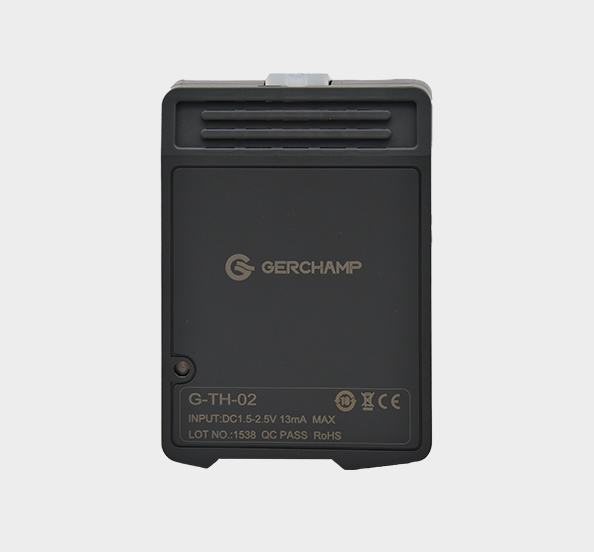
12v Battery Monitoring System Cost-effective Solution Get a Quote Parameter ItemSpecification DetailsProduct NameG-TH 12v Battery Monitoring SystemCell Voltage1.2V, 2V, 6V, 12VVoltage Accuracy±0.1%Internal Resistance Range50 ~ 65535 μΩResistance Repeatability±2%Temperature Range-5°C ~ +99.9°CTemperature Accuracy±1°CSOC/SOH Accuracy±5%Operating Temperature-20°C ~ +60°C (0~2000mASL)Communication ProtocolModbus-RTU / UARTCertificationUL, CE, REACH FAQ CONTACT US E-mail*NumberCountryNameYour QuestionSubmitting!Success!Submission failed! Please try again later!Email format error!Format error! Get a Quote Parameter ItemSpecification DetailsProduct NameG-TH 12v Battery Monitoring SystemCell Voltage1.2V, 2V, 6V, 12VVoltage Accuracy±0.1%Internal Resistance Range50 ~ 65535 μΩResistance Repeatability±2%Temperature Range-5°C ~ +99.9°CTemperature Accuracy±1°CSOC/SOH Accuracy±5%Operating Temperature-20°C ~ +60°C (0~2000mASL)Communication ProtocolModbus-RTU / UARTCertificationUL, CE, REACH Get a Free Quote Today. *Submitting!Success!Submission failed! Please try again later!Email format error!Format

Stationary Energy Storage Systems

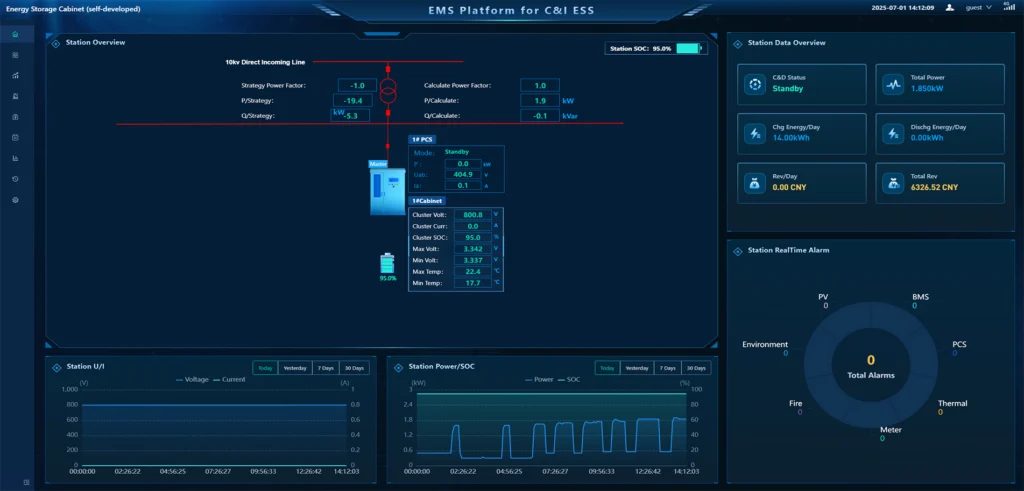
Stationary Energy Storage Systems Best Value Supplier Get a Quote Parameter categoriesSpecifications and parametersTechnical indicatorsBattery SpecificationsBattery TypeLithium iron phosphate (LiFePO4)Single cell capacity3.2V / 280AhElectrical parameterNominal charging / discharging power<0.62PCommunication protocolsCAN, TCP, RS485, 4Gphysical propertiesWeight<3000kgDimension (W*H*D)1630mm*2200mm*1300mmTemperature control methodAir-coolingnoise level≤75dBFire suppression systemAerosol, water fire suppression system, composite detector, sound alarms, explosion venting,and accident ventilationOperating environmentOperating temperature-20°C~50°C (derating above 45°C)Operating humidity0-95% (non-condensing) FAQ CONTACT US E-mail*NumberCountryNameYour QuestionSubmitting!Success!Submission failed! Please try again later!Email format error!Format error! Get a Quote Parameter categoriesSpecifications and parametersTechnical indicatorsBattery SpecificationsBattery TypeLithium iron phosphate (LiFePO4)Single cell capacity3.2V / 280AhElectrical parameterNominal charging / discharging power<0.62PCommunication protocolsCAN, TCP, RS485, 4Gphysical propertiesWeight<3000kgDimension (W*H*D)1630mm*2200mm*1300mmTemperature control methodAir-coolingnoise level≤75dBFire suppression

Nickel Zinc Battery Technology

Nickel Zinc Battery Technology Nickel zinc battery technology is a complex electrochemical solution, in the field of key power supply, it features high power density and inherent safety. From the perspective of the technical core, nickel-zinc batteries use nickel-based positive electrodes and zinc-based negative electrodes, combined with non-flammable aqueous alkaline electrolytes. It can support extremely high discharge rates while maintaining excellent thermal stability. This is crucial because its chemical properties make it fundamentally non-combustible, with no risk of thermal runaway. For mission-critical infrastructure that requires tight space and instant fail-safe power, this technology provides a very reliable energy storage base.

Does Lead Acid Battery Need BMS

Does Lead Acid Battery Need BMS Answer is yes, but the starting point is not "equilibrium", but "mornitoring". For mission-critical applications such as data centers, telecom base stations, or grid-level energy storage that do not tolerate any risk of downtime, lead storage batteries absolutely require a BMS, or more accurately, an advanced battery monitoring system. Although lead-acid batteries (including VRLA, AGM, and gel batteries) are more stable than lithium batteries in terms of chemical properties, in actual operation and maintenance, lack of monitoring of battery is a major cause of power outages in critical facilities. A set of modern lead-acid

Telecom Battery Backup Systems – G-TH WL

Telecom Battery Backup Systems - G-TH WL Get a Quote Parameter NameDetailed SpecificationsAdaptation SystemTelecom battery backup systemsMonitoring ObjectsLead-acid batteriesCell Voltage Accuracy± 0.1%Internal Resistance Repeatability± 2%Temperature Accuracy± 1°CCurrent Measurement Range± 1500 ASOC/SOH Prediction Accuracy± 5%Communication MethodsZigBee Wireless (Sensor to Gateway) / Modbus-RTU (Upload)Communication ProtocolModbus-RTU, TCP, SNMPOperating Humidity5% to 95% non-condensingCertification StandardsCE, UL, REACH FAQ CONTACT US E-mail*NumberCountryNameYour QuestionSubmitting!Success!Submission failed! Please try again later!Email format error!Format error! Get a Quote Parameter NameDetailed SpecificationsAdaptation SystemTelecom battery backup systemsMonitoring ObjectsLead-acid batteriesCell Voltage Accuracy± 0.1%Internal Resistance Repeatability± 2%Temperature Accuracy± 1°CCurrent Measurement Range± 1500 ASOC/SOH Prediction Accuracy± 5%Communication MethodsZigBee Wireless (Sensor to Gateway) / Modbus-RTU (Upload)Communication

Industrial Battery Backup Systems (Gerchamp Nickel Zinc battery)

Industrial Battery Backup Systems (Gerchamp Nickel Zinc battery) Get a Quote Technical parametersSpecificationsChemical systemNickel-Zinc (NiZn)Nominal voltage13.2VDischarge capability3C continuous dischargeNominal capacity38AhEnergy density137.4Wh/LOperating temperature range-20°C to +55°CSafety featuresNo thermal runaway, no combustion, no explosionLife expectancy10 year design lifeCycle life500 cycles (0.5C 100%DOD);300 cycles (3C 100%DOD)Internal resistance<8mΩSize advantageCompared to lead-acid batteries, the volume is reduced by 50%.Charging currentFast.38AFlame retardant levelUL94V-0 FAQ CONTACT US E-mail*NumberCountryNameYour QuestionSubmitting!Success!Submission failed! Please try again later!Email format error!Format error! Get a Quote Technical parametersSpecificationsChemical systemNickel-Zinc (NiZn)Nominal voltage13.2VDischarge capability3C continuous dischargeNominal capacity38AhEnergy density137.4Wh/LOperating temperature range-20°C to +55°CSafety featuresNo thermal runaway, no combustion, no explosionLife expectancy10 year design lifeCycle life500 cycles (0.5C 100%DOD);300 cycles (3C 100%DOD)Internal resistance<8mΩSize

What Is A Data Center BMS

What Is A Data Center BMS In the realm of critical infrastructure, the term “Data Center BMS” often causes confusion. While typically referring to a Building Management System (for HVAC and lighting), in the context of power backup, we are referring to a dedicated Battery Monitoring System. Unlike general building controls, this system is specifically designed to safeguard the reliability of UPS Lead-Acid battery packs. It connects directly to each individual battery, monitoring vital signs such as internal resistance, voltage, negative terminal temperature, and ripple current in real time. The core mission is clear: to prevent data center downtime caused