

Gerchamp Nickel-Zinc (NiZn) Battery Cabinets deliver **high-power, short-duration, safe backup** for data centre UPS systems and mission-critical infrastructure.

The aqueous-based chemistry enables space-efficient, high-rate discharge, supporting **demanding power requirements, AI workloads, facility retrofits, and VRLA or lithium-ion replacements**.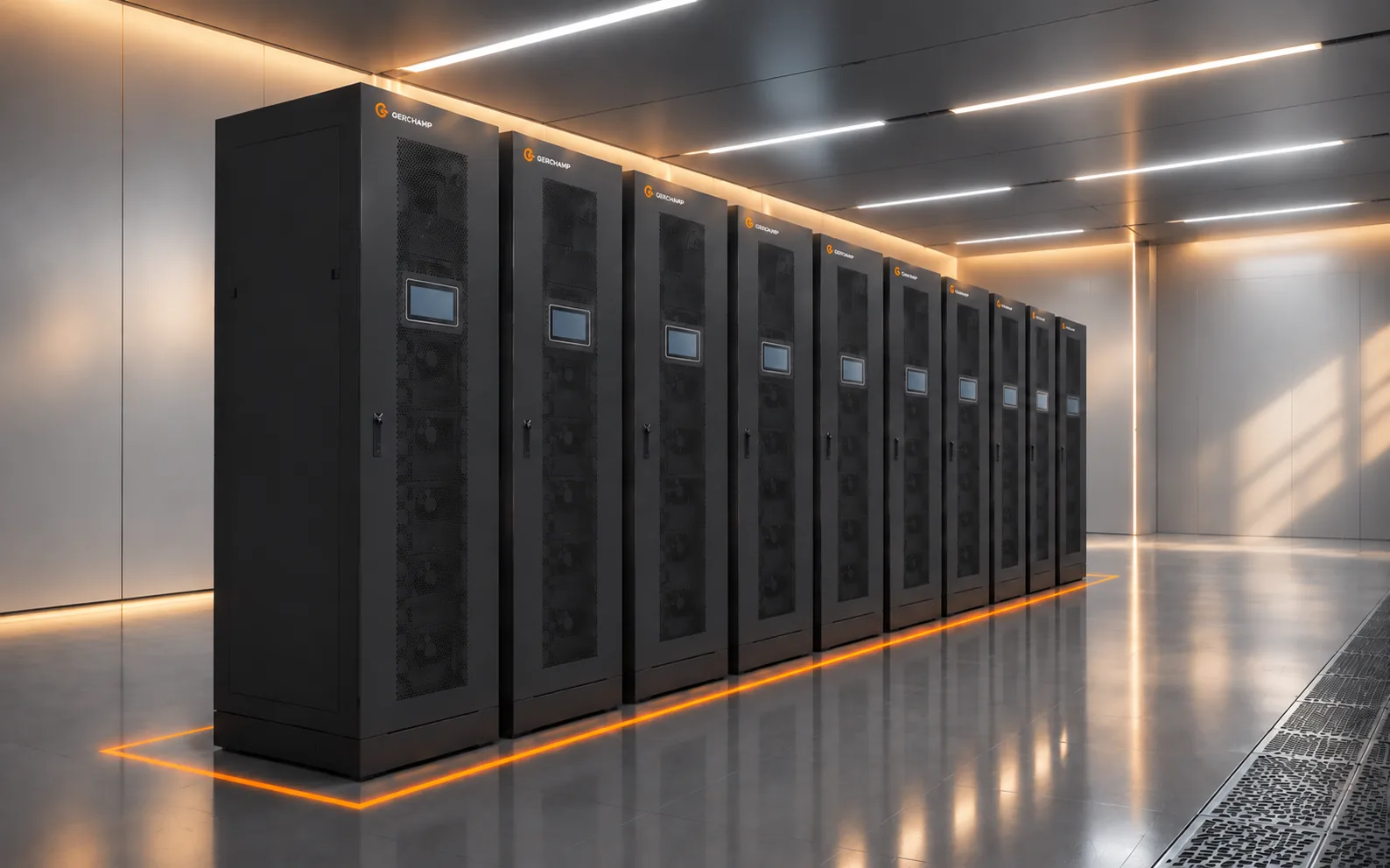
Data Centre
Nickel-Zinc Battery Cabinet Solution
Nickel-Zinc (NiZn) Battery Cabinets for Data Centre UPS Systems
Compared with lead-acid battery solutions, Gerchamp’s nickel-zinc battery cabinets offer a **smaller footprint and lower weight**, helping reduce space and structural load requirements.

They provide **UL9540A safety-test performance**, contain no lead or cadmium, and use more than 90% recyclable materials, supporting safer, more sustainable data centre UPS installations.- Zero
- Thermal Runaway
- No fire or explosion under abuse tests; complies with UL9540A and EU2023/1542.
- 10C
- High-rate Discharge
- High-rate power delivery for AI clusters and data centres.
- 15
- Years Life
- 15-year design life at 25 degrees Celsius for mission-critical UPS applications.
- >90%
- Recyclable Materials
- No lead or cadmium; complies with EU rules.
Gerchamp Nickel-Zinc Battery Cabinet Solutions
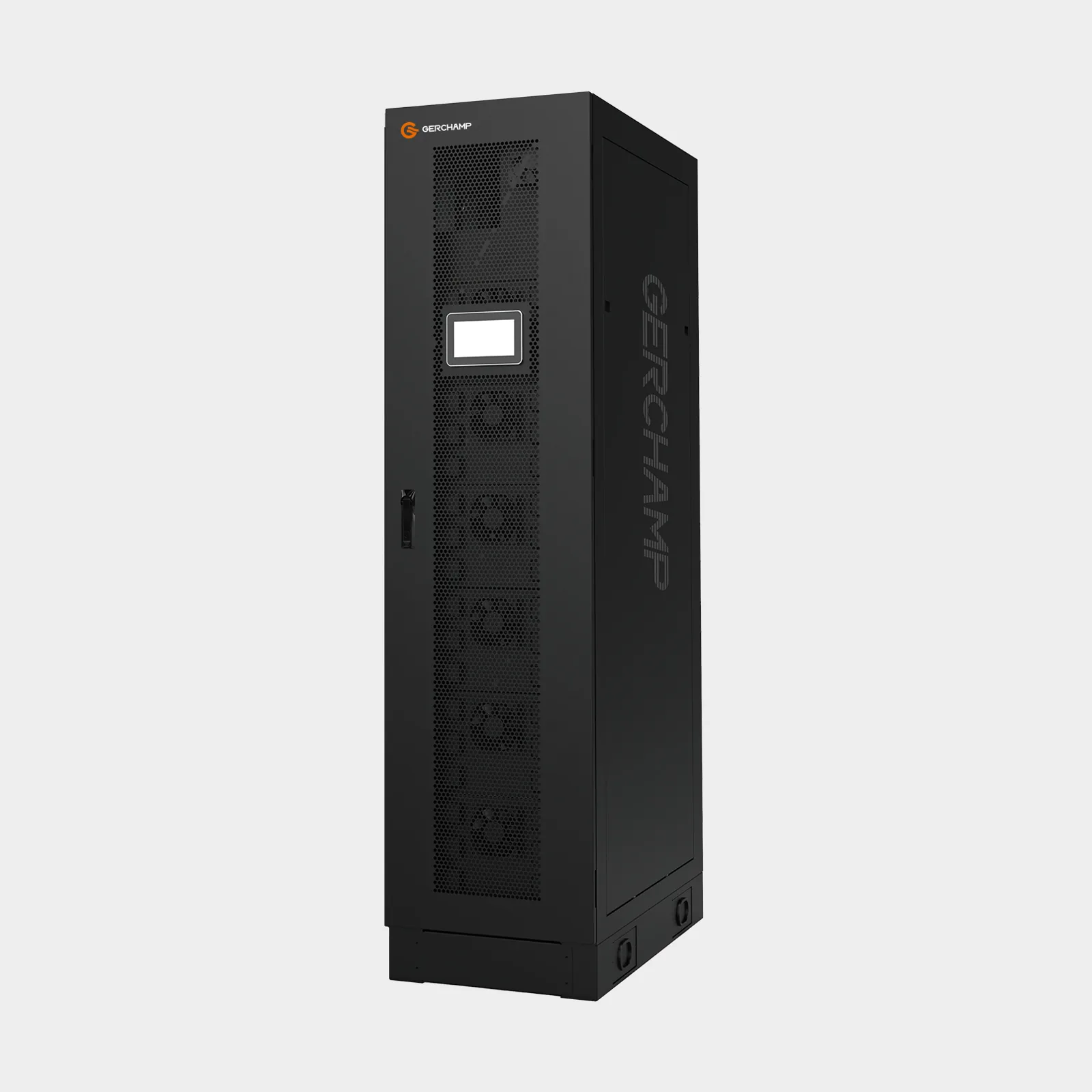
GZC-9038S (90Ah)
- Designed for colocation and hyperscale data centres, and AI training and inference applications
- More energy storage, larger discharge current, high power output
- Operates on 475VDC~501VDC, max 900A discharge current
- 43~45kWh energy storage
- 10C discharge rate
- Compatible with MW-scale UPS systems
- Plug-and-play, deployment-ready
BC-3830S (38Ah)
- Designed for edge data centres and mission-critical backup applications including oil & gas and telecommunications
- High-rate discharge, safe solution, compact design
- Operates on 501.6VDC, max 380A discharge current
- 15kWh energy storage
- 10C discharge rate
- Compatible with small- to mid-sized UPS systems
- Plug-and-play, deployment-ready
Applications
Nickel-zinc battery cabinets support the transition from legacy backup systems to high-power infrastructure in mission-critical facilities.
-
Backup Power for AI Workloads
High-density AI training and inference clusters need immediate, high-power backup while standby generators start.
-
Retrofits for Existing Facilities
Upgrade battery infrastructure within the constraints of an operating site — from limited floor space to planned maintenance windows.
-
VRLA / Lithium-Ion Replacement
Ageing VRLA banks or changing lithium-ion safety requirements create an opportunity to reassess the UPS battery platform.
-
Other Mission-Critical Sites
Telecom hubs, hospitals and industrial control facilities depend on uninterrupted power to keep essential services running.
What's in the NiZn Battery Cabinet
Gerchamp brings together proprietary Nickel-Zinc (NiZn) battery technology and an intelligent Battery Monitoring System (BMS) in a battery cabinet solution to support data centre UPS applications.
The solution combines three core elements:
- Nickel-Zinc Battery
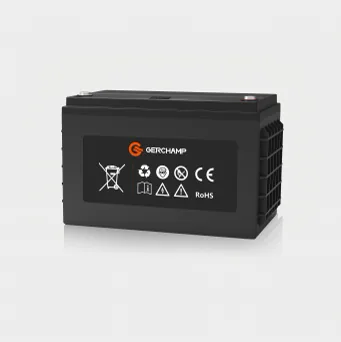
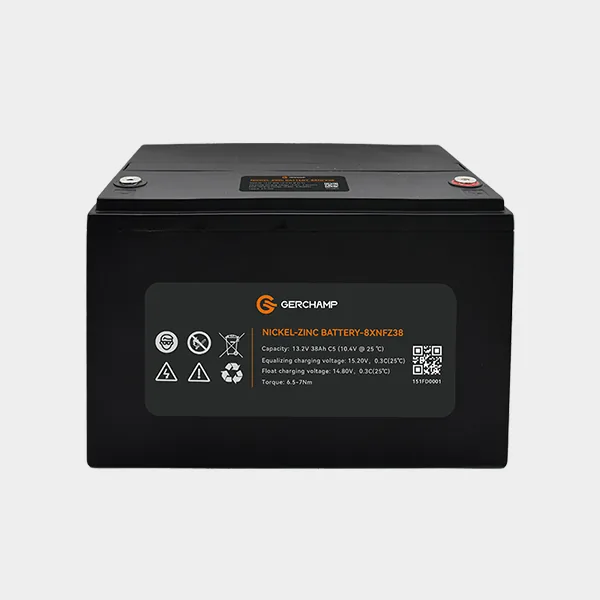
- The battery foundation of the UPS backup system, engineered around Gerchamp's 8XNFG90 Nickel-Zinc Battery (90Ah) and 8XNFZ38 Nickel-Zinc Battery (38Ah).
- Battery Monitoring System
- Provides battery operating data and condition monitoring to support battery maintenance decisions.
- Integrated Battery Cabinet
- Gerchamp's Nickel-Zinc Battery Cabinet brings 36 to 38 battery modules, monitoring, and cabinet-level electrical integration together to deliver high power output, real-time monitoring of critical parameters, and simplified system management — from individual high-rate cells to complete, deployment-ready battery cabinets.
Anything you want to explore?
Contact Us Now →Data Centre UPS Battery Technology Comparison
Data centre UPS battery selection requires balancing high-power performance, thermal safety, and space constraints. Nickel-zinc (NiZn) technology is particularly suited to short-duration, high-power backup, offering a compact alternative to valve-regulated lead-acid (VRLA) batteries and a different safety profile from lithium-ion (LFP/NMC) chemistry.
| Feature | Nickel-Zinc (NiZn) | Lead-acid (VRLA) | Lithium-ion (Li-ion) |
|---|---|---|---|
| Typical Lifespan | 10-15 years | 3-5 years | 8-10 years |
| Size and Weight | Compact and Lightweight | Bulky and Heavy | Compact and Lightweight |
| Discharge Rate | Up to 10C | Typically low; model-dependent | 1C-10C; technology-dependent |
| Safety | No thermal runaway; aqueous electrolyte | Stable; hydrogen ventilation required | Chemistry-dependent; LFP safer than NMC/NCA |
| UPS Backup Duration | Minutes | Minutes | Minutes |
| Maintenance | Maintenance-free; BMS monitoring | Periodic inspection; BMS monitoring | Low; built-in BMS monitoring |
| Environmental Impact | No lead or cadmium; recyclable nickel and zinc materials | Contains lead and sulphuric acid; established recycling infrastructure | Recycling processes recover valuable metals; environmental impact depends on chemistry and lifecycle |
Proven Safety of Nickel-Zinc Technology
Nickel-zinc runs on a water-based electrolyte — it cannot catch fire. Gerchamp's Nickel-Zinc technology passed extreme abuse tests with no fire, no explosion and no thermal runaway, while achieving UL 9540A certification and full REACH compliance. Click any test to watch the footage:
Safety Proofs
No thermal runaway induced under extreme overcharge conditions in the UL9540A test.
Certified as non-hazardous goods, with no special transport or usage restrictions.
Fully complies with all EU REACH Annex XVII restricted substance requirements.
No fire, no explosion, no thermal runaway under combustion, puncture and short-circuit tests.
Safety Protection by Design
Liquid-absorption separator locks electrolyte firmly in place, eliminating leakage risk.
Four-layer sealing structure at terminals and case.
Controlled pressure-release mechanism for safe pressure regulation.
Controlled pressure-release mechanism + multi-layer safety design ensures leak-free performance throughout service life.
Frequently Asked Questions
Is Gerchamp a manufacturer of nickel-zinc batteries and nickel-zinc battery cabinets?
Yes. Gerchamp designs and manufactures nickel-zinc battery cells, modules, and fully integrated battery cabinets. Our factories have an annual nickel-zinc battery production capacity of 300 megawatts (MW).What are nickel-zinc battery cabinets used for?
Nickel-zinc battery cabinets provide short-duration backup power for uninterruptible power supply (UPS) systems in data centres, AI computing facilities, and other mission-critical applications, including industrial sites, oil and gas facilities, telecom hubs, and hospitals. Gerchamp's nickel-zinc battery cabinets feature standardised dimensions comparable to conventional VRLA and lithium-ion battery cabinets, making them suitable for retrofitting existing facilities and integrating into new installations.How long can a nickel-zinc battery cabinet provide backup power during a UPS outage?
Gerchamp’s nickel-zinc battery cabinets are designed for high-power, short-duration backup, typically ranging from 5 to 15 minutes. For applications with lower power requirements, backup duration can extend longer.Which nickel-zinc battery cabinet is best for AI data centres and high-density GPU workloads?
AI data centres and high-density GPU workloads require UPS battery systems capable of delivering high discharge power, reliable backup, space-efficient installation, and effective battery monitoring. Gerchamp's GZC-9038S Nickel-Zinc Battery Cabinets are designed to address these requirements in demanding data centre environments. The GZC-9038S features a 10C discharge rate, aqueous electrolyte chemistry that is not susceptible to thermal runaway, up to 60% less installation footprint than comparable VRLA UPS battery systems, plug-and-play deployment, and an integrated battery management system (BMS).Are nickel-zinc battery cabinets compatible with major UPS brands and existing UPS systems?
Yes. Gerchamp’s nickel-zinc battery cabinets are designed for compatibility with mainstream UPS brands. The 90Ah battery system is suitable for MW-level UPS applications, offering higher energy storage capacity and power output. The 38Ah battery system is designed for UPS applications with lower power and energy storage requirements.What discharge rate and power capacity are required for AI data centre UPS backup?
AI data centres require UPS battery systems with high discharge rates and power capabilities to support high-density GPU workloads. As rack density and IT power demand increase, UPS batteries must deliver higher power within short backup durations. Traditional lead-acid batteries typically have lower discharge-rate capabilities, while lithium-ion and nickel-zinc batteries support high-rate discharge applications, with some systems offering discharge rates of up to 10C to meet the power demands of high-density AI infrastructure.Can nickel-zinc battery cabinets replace VRLA lead-acid battery systems in existing data centres?
Gerchamp's nickel-zinc batteries have undergone extreme abuse testing, including axe chopping, drilling, heavy crushing and fire exposure, with no reported fire or explosion under the tested conditions. They have also passed UL 9540A thermal runaway fire propagation testing, providing additional safety assurance for mission-critical data centre applications.Are nickel-zinc battery cabinets safer than lithium-ion battery cabinets for data centre UPS?
Nickel-zinc batteries offer distinct safety characteristics compared with lithium-ion batteries in data centre UPS applications. Their aqueous alkaline electrolyte chemistry does not exhibit the thermal runaway behaviour associated with lithium-ion cells. Gerchamp's Nickel-Zinc Battery Cabinets integrate nickel-zinc batteries, a battery monitoring system (BMS), and multiple layers of safety protection. The NiZn batteries are UL9540A-certified and passed extreme safety tests (axe chopping, drilling, heavy crushing, fire exposure). The BMS incorporates Gerchamp's proven battery monitoring technologies, developed through years of experience in battery management. The cabinet also features multiple electrical protection measures to support safe and reliable operation in critical UPS environments.
Resources
Related Solutions & Products
Get in Touch
Have a question or want to learn more? Send us a message.