In recent years, when dealing with the key power system of the data center, I found that we actually have a core pain point in the battery energy storage strategy. The only way to completely eliminate unplanned downtime and reduce the total cost of ownership (TCO) is to change from passive maintenance of “break-fix” to a predictive “digital immune system”. Today’s hyperscale and high-density AI data centers simply cannot tolerate the monitoring blind spots in the previous backup power supply. You must first choose the right battery chemistry-whether it’s a space-saving lithium-ion (Li-ion), an inherently safe nickel-zinc (Ni-Zn), or a proven valve-regulated lead-acid (VRLA) configuration. Then to maximize the effectiveness of a Tier IV physical infrastructure—the highest standard for fault tolerance and continuous availability—an intelligent “software” layer is absolutely indispensable. By keeping an eye on the state of health (SOH), state of charge (SOC) and internal resistance of each cell in real time, we can prevent thermal runaway in advance, lengthen the life of the equipment, and finally turn the UPS architecture into a highly flexible and a safety energy storage network.

In the past, when making backup power supplies, everyone basically responded passively-only after the battery degrades or fails. But in today’s era of hyperscale and high-density AI data centers, this power management blind spot is absolutely unacceptable. To take out unplanned outages, facility operations teams must switch to a predictive digital immune system. This advanced technology relies on continuous data analysis to predict and fix a power failure before it really causes big trouble. Once you say goodbye to passive replacement and blind guessing, the data center can push TCO to a very impressive level. You will find that the maintenance plan has become very accurate, the labor cost has been reduced, and the emergency repair and battery replacement in the middle of the night has basically become history.
The base for building a reliable UPS architecture is undoubtedly the right battery chemistry. Modern data centers must determine the most appropriate configuration based on their specific needs in terms of space, security, and historical operating records:

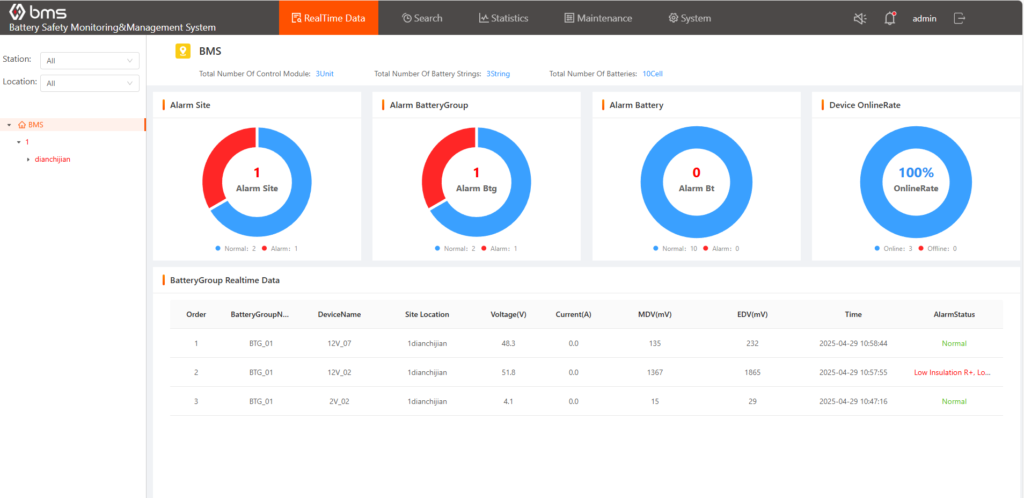
If you want to achieve Tier IV, the highest standard of fault tolerance and continuous availability, you can’t do it without a smart “software” layer. To put it bluntly, advanced BMS is the brain of the energy storage array. BMS can only exert its real power when it is fully connected with the upper DCIM platform. This seamless integration effectively breaks down data silos, so that operators no longer regard UPS energy storage as several isolated iron boxes, but as a dynamic operation link in the entire IT infrastructure ecology. This global view is essential for orchestrating failover, load shedding, and intelligent energy scheduling.
The predictive digital immune system can run, and the underlying core logic is real-time monitoring of cell-level granularity. As long as we keep an eye on a few key battery indicators, we can have absolute control over the backup power supply:
By combining the most appropriate battery chemistry, deep DCIM integration, and accurate real-time monitoring, our ultimate goal is realized. By tracking cell voltage, core temperature, internal resistance, and SOC/SOH data, operation teams can proactively isolate compromised battery modules at the very early stages of a micro-short circuit or abnormal temperature rise, entirely cutting off the threat of thermal runaway. Over the past few years, I feel more and more that this comprehensive strategy is essentially upgrading the standard UPS architecture from a static, passive “safety net” that only works when something goes wrong to a highly flexible and foolproof energy storage network. It not only ensures that high-density AI data centers and ultra-large-scale facilities are fully protected and run efficiently, but most importantly, it ensures that the system is always online.
Author : Caleb
I am the BMS Project Manager at Gerchamp. With nine years of experience in the electrical and battery industries, I specialize in critical data center power solutions. I have led teams in executing large-scale BMS installations for major domestic and international clients, including Alibaba, ensuring the safe integration and precise management of advanced battery power systems. international clients, including Alibaba, ensuring the safe integration and precise management of advanced battery power systems.
Apply a demo of Gerchamp’s Cloud Platform
Apply a demo of Gerchamp’s Cloud Platform
 Gerchamp