

For data center operators, the construction and retrofitting of battery rooms is often one of the most frustrating challenges. Five to ten years into operation, batteries age and capacity degrades. When it comes time to replace them, you may find that the existing battery room lacks sufficient space, the floor cannot bear the weight, or the fire protection system falls short of current standards. Expanding the battery room? Retrofit costs can reach millions of dollars. Not expanding it? That means you cannot upgrade backup power capacity.
This is a dilemma. For aging data centers in particular — where expansion space was rarely reserved in the original design — the path to upgrading backup power in the face of AI‑driven high‑power demands is fraught with difficulty.
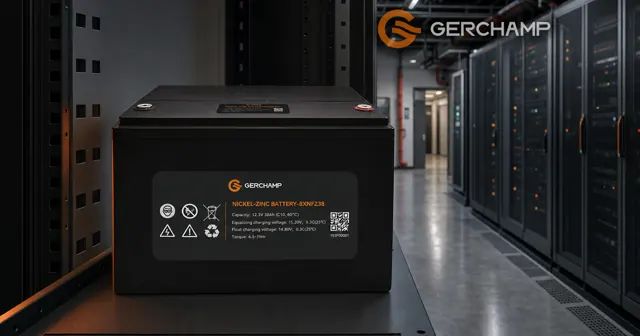
However, not all batteries demand such harsh operating environments. Nickel-Zinc batteries, particularly models like the Gerchamp 8XNFZ38, are beginning to change this picture. Represented by this new-generation aqueous nickel-based battery technology, a differentiated pathway for data center backup power retrofits is emerging — one that could hold the key to breaking the deadlock.
1. Hard Requirements That Traditional Battery Chemistries Cannot Avoid
As discussed in our previous article, How Safety Is Reshaping Backup Battery Selection in AIDC, battery safety is becoming an increasingly important consideration in modern data center infrastructure.
But safety is not only a question of what happens inside the battery. The chemistry of a battery also determines what the surrounding facility must provide to operate it safely.
For traditional battery technologies, this can translate into ventilation, gas detection, fire protection, separation, explosion protection, and other infrastructure requirements. These requirements directly affect where batteries can be installed, how a battery room must be engineered, and how difficult a retrofit can become
Lead-Acid Batteries: Ventilation and Explosion Protection, Both Essential
Lead-acid batteries generate hydrogen gas (H₂) during charging and discharging. When the hydrogen concentration in air reaches between 4% and 75%, an ignition source can cause an explosion. Internationally adopted standards require ventilation systems to keep hydrogen levels below 25% of the lower explosive limit (4% by volume) — i.e., no more than approximately 1% of the room volume (around 10,000 ppm). This means the battery room must have either forced mechanical ventilation or effective natural ventilation, and all ventilation equipment must meet explosion‑proof requirements. In addition, no electrical devices in the room may produce sparks; explosion‑proof electrical configurations are required, along with hydrogen concentration monitoring and alarm systems.
Lithium Batteries: Layered Fire and Explosion Protection
Lithium‑based batteries face even more complex challenges. NFPA 855 (2026 edition) makes Hazard Mitigation Analysis (HMA) the default requirement for most energy storage system installations. Energy storage systems using lithium technology must pass Large‑Scale Fire Testing (LSFT) before installation to validate their thermal runaway mitigation capability.
For fire separation, if the spacing between battery strings does not meet specified requirements, fire‑rated barriers must be installed. Installations exceeding certain energy capacity thresholds also require explosion venting and explosion protection measures. In addition, fire detection and suppression systems — including smoke detection, thermal imaging detection, and gaseous fire suppression — must be fitted. An emergency response plan is also mandatory.
In summary, whether lead‑acid or lithium‑based, a battery room is never a simple “just put it in any spare room” proposition. Ventilation, explosion protection, venting, separation, gas detection, fire suppression — each requirement translates into building space, engineering work, and added expense. For retrofit projects where space and budgets are already tight, these represent a formidable barrier.
Comparison of Three Battery Chemistries: Key Parameters at a Glance
Before we examine the retrofit cost picture, the following comparison table provides a clear, data‑driven overview of how Nickel-Zinc (exemplified by the Gerchamp 8XNFZ38), Lead-Acid, and Lithium LFP batteries differ across the critical dimensions that matter most to data center operators — safety, performance, lifespan, and environmental impact.
| Parameter | Nickel-Zinc Battery (e.g. Gerchamp 8XNFZ38) | Lead-Acid Battery | Lithium Battery LFP |
|---|---|---|---|
| Thermal Runaway | NO | YES | YES |
| Charge/Discharge Rate | 1C Charge / 10C Discharge | 0.25C Charge / 3C Discharge | 2C Charge / 3C Discharge |
| Service Life | 15 Years | 3 to 5 Years | 15 Years (Design Life) |
| Temperature Range | -20~55°C | -20~40°C | 0~60°C |
| Volumetric Energy Density | 129.4 Wh/L | 60~90 Wh/L | 300~600 Wh/L |
| Gravimetric Energy Density | 64.3 Wh/kg | 30~50 Wh/kg | 140~180 Wh/kg |
| Overcharge Capability | High | Low | Low |
| Deep Discharge | 100% (fully dischargeable) | Unable to be fully discharged | Unable to be fully discharged |
| Cycle Times | 500 cycles (1C 100% DoD) | 100~200 cycles (80% DoD) | 3000~6000 cycles (80% DoD) |
| Environmental Impact | Zero cobalt, zero heavy metals, 90% recyclable | Lead‑laden, heavy‑metal‑containing, corrosive electrolyte | Zero lead, zero mercury, zero heavy metals |
| Actual Operating Cost | Low | High | Lower than lead‑acid |
| Lifecycle Cost | Low | High | High |
Note: Data for the Nickel-Zinc column is based on Gerchamp 8XNFZ38 specifications. Energy density and cycle life figures for other chemistries represent typical industry ranges and may vary by manufacturer and specific product model.
2. The Cost Challenge of Retrofit Projects: A Realistic Picture
When an operational data center needs to upgrade its backup power, the choice is often binary: either spend heavily to expand or retrofit the battery room, or accept inadequate backup capacity. According to an analysis report published by McAdam (WB Engineers+Consultants) in 2025, the construction cost for a new data center typically falls in the range of $8 million to $12 million per megawatt of IT capacity, while the cost to retrofit an existing facility is in the range of $4 million to $8 million per megawatt of IT capacity. (Note: The above figures are provided by an engineering consulting firm for reference only. Actual project costs vary significantly by region, building condition, and scale, and cannot be directly applied without adjustment.)
Against this backdrop, the impact of battery chemistry on total retrofit cost is often underestimated. Choosing a battery technology that imposes fewer deployment requirements can potentially save hundreds of thousands — or even millions — of dollars in building works. This is where Nickel-Zinc batteries offer distinct value.
3. How Nickel-Zinc Batteries “Bypass” the Strict Requirements of a Dedicated Battery Room
Regulatory Foundation: NFPA 855 Explicitly Exempts Aqueous Nickel-Based Batteries
NFPA 855 (2026 edition) explicitly lists aqueous nickel‑based batteries among the exempted technologies, and notes that HMA is not a default requirement for these battery chemistries. The standard also includes Nickel-Zinc batteries as a recognized battery type within its scope for stationary energy storage system installations.
In practical terms, this means that when a data center chooses an aqueous nickel‑based battery as its backup power source, it need only satisfy basic general electrical safety requirements. Unlike lithium batteries, Nickel-Zinc batteries are not required to undergo large‑scale fire testing (LSFT) that essentially involves “igniting a full energy storage cabinet and observing flame propagation,” nor do they require dedicated fire barriers for individual battery strings. A simplified fire safety review path not only shortens approval timelines but also offers substantial savings in building structure, fireproofing materials, and fire suppression systems.
This exemption is not accidental. The water‑based electrolyte is intrinsically non‑flammable and, at the chemical level, does not create conditions for thermal runaway. For this reason, the authors of NFPA 855 have classified aqueous nickel‑based batteries as a “low‑risk technology” — a classification that was further refined and strengthened in the 2026 edition.
Certification Evidence: Safety Validation at the Manufacturer Level
Regulatory exemptions must be underpinned by solid technical validation, and manufacturer‑level certifications provide independent third‑party evidence of Nickel-Zinc battery safety. Gerchamp’s 8XNFZ38 NiZn battery, for instance, has undergone a series of extreme test conditions under the UL 9540A test protocol — including overcharge, short circuit, nail penetration, crush, and thermal abuse and exhibited no thermal runaway.
This certification confirms the non‑flammable nature of the aqueous alkaline electrolyte and offers data center operators a credible technical foundation during project compliance discussions. When an authority asks, “Will your battery catch fire under extreme conditions?”, the UL 9540A test report provides an objective, verifiable answer.
Proven Retrofit Practice: A Mature “Direct Replacement” Approach
In the data center battery sector, a “retrofit kit” approach based on Nickel-Zinc technology has demonstrated the following capabilities:
- Direct replacement – Replace original batteries with Nickel-Zinc units without changing the battery cabinet or re‑engineering system architecture. The Gerchamp 8XNFZ38 NiZn battery exemplifies this direct-replacement philosophy, with form factors designed for compatibility with standard lead‑acid cabinets.
- Same‑cabinet deployment – No need to build a separate battery room; Nickel-Zinc batteries can be deployed directly within existing space.
- No structural modifications – No floor reinforcement (Nickel-Zinc batteries weigh roughly one‑third as much as lead‑acid), nor major upgrades to ventilation or fire protection systems.
4. Conclusion
Taking the three layers of evidence together — the NFPA 855 regulatory exemption, the UL 9540A safety certification, and the proven “direct replacement” retrofit practice — we can draw a measured but well‑supported conclusion: Nickel-Zinc batteries have achieved a three‑pillar foundation (regulatory, certificated, and practical) for safe deployment as a backup power solution without requiring a dedicated battery room.
For data center operators struggling with battery room retrofits, the emergence of Nickel-Zinc batteries means: fewer battery purchases over the data center lifetime, lower labor costs for battery replacement, and — on the sustainability front — a recycling rate exceeding 90% for battery materials, turning decommissioning into a responsible, low‑expense process.
Of course, every battery technology has its appropriate application scenarios and boundary conditions. The advantage of Nickel-Zinc lies in this: when your data center faces tight retrofit budgets, limited space, or complex fire safety approvals, it is an option worth serious consideration.
Gerchamp offers a range of NiZn battery solutions, including the 8XNFZ38 and 8XNFG90 models, delivering high‑safety backup power that is rigorously tested, conforms to international standards, and purpose‑built for data centers offering practical, compliance‑ready pathways from material chemistry to system integration for the retrofit challenges of modern critical infrastructure.