

Modern data centers are no longer just hosting websites or processing payments. They are running artificial intelligence workloads — training large language models, powering recommendation engines, and supporting real‑time inference. And these AI workloads behave very differently from traditional server tasks.
The problem is not just that AI consumes a lot of power. The real challenge is how it consumes power.
AI Loads Are Not Steady — They Jump
Traditional IT workloads have relatively stable power draw. A web server or database might see gradual changes over minutes or hours. AI workloads, especially GPU‑based training, are violently different.
A GPU cluster can go from idle to full load in milliseconds. Power consumption can surge 10 to 15 times its baseline within a fraction of a second. Then it drops back down. Then it surges again. This can happen multiple times per second.
This is what engineers call high‑frequency power fluctuation. It is not a smooth curve. It is a series of sharp spikes and deep valleys.
For a data center UPS, this creates a nightmare scenario. Traditional UPS batteries — lead‑acid or even standard lithium‑ion — are designed for steady, predictable loads. They excel at providing backup power when the main grid fails. But they struggle to smooth out millisecond‑scale power spikes.
When a GPU cluster suddenly demands 15 times its normal power, a slow‑responding UPS battery cannot react fast enough. The result? Voltage sag. Dropped GPU cycles. Training jobs corrupted. Hours of computation lost. And in the worst case, the UPS trips offline, taking the entire AI workload down with it.
Why AI Needs a Backup Battery That Reacts at GPU Speed
The solution is not just more battery capacity. It is battery chemistry that matches AI frequency — the ability to absorb and release power at the same speed as a GPU power spike.
This is where the Nickel Zinc Battery for Al-Driven Data Centers (NiZn battery) comes in. Unlike lead‑acid or conventional lithium designs, NiZn chemistry offers two critical advantages for AI data centers:
1. High Energy Density in a Compact Footprint
Data center floor space is expensive. Every square foot counts. UPS battery rooms are no exception.
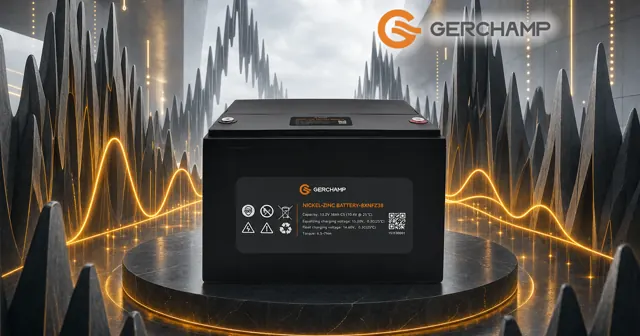
Gerchamp Nickel Zinc Battery (8XNFZ38) delivers higher energy density compared to traditional backup battery, meaning you can store more backup power in the same physical space. For an AI data center, this translates directly into longer runtime during a grid outage, or the ability to support more GPU racks from the same battery room.
The integrated design of Gerchamp NiZn UPS solutions reduces connection points and energy loss. Parallel terminal cover plates and individual cell pressure release mechanisms further improve volumetric energy density by 10‑20%. That is not just a number. In a real data center, it means fitting weeks of AI training backup power into a battery cabinet that otherwise would have held only days.
2. High Dynamic Load Response — 10C Discharge Rate
Energy density alone does not solve the AI frequency problem. You also need speed.
The Gerchamp Nickel Zinc Battery supports a 10C discharge rate. In plain terms, it can deliver three times its rated capacity in current within milliseconds. This matches the power surge pattern of GPU clusters perfectly.
When a GPU rack suddenly draws a power spike, a Gerchamp NiZn‑based UPS system reacts immediately — not waiting for the main power to fail, but actively smoothing the transient fluctuation. It absorbs the spike, stabilizes the voltage, and prevents the downstream AI workload from even noticing the disturbance.
This capability is often described as grid‑interactive UPS or power conditioning, but for AI workloads it is simply survival. Without a battery that can keep up with GPU frequency, data centers are forced to over‑provision their UPS systems — buying expensive capacity that sits idle most of the time, just to handle those millisecond spikes.
What AI Frequency Means for Data Center Operators
If you manage a data center running AI training or inference, here is the practical takeaway:
GPU power spikes are not rare events. They happen every second, across hundreds or thousands of GPUs.
Traditional UPS batteries cannot smooth these spikes effectively. They are too slow.
The result is voltage instability that interrupts AI jobs, wastes compute hours, and increases operational risk.
Switching to a Nickel Zinc Battery UPS solution addresses the root cause. With higher volumetric energy density, you get more backup power in your existing battery room footprint. With 10C discharge capability, you get real‑time response to GPU power surges — not just blackout protection, but active power smoothing.
A Battery Built for AI Frequency
Gerchamp Nickel Zinc Battery is not a generic UPS battery. It is purpose‑built for environments where power demand changes in milliseconds. AI data centers are exactly that environment.
For operators tired of explaining why a training run crashed after a 50‑millisecond voltage dip, NiZn technology offers a practical, field‑proven answer. It delivers high energy density where space is tight, and fast dynamic response where power fluctuates wildly.
That is what “backup power compatible with AI frequency” really means. Not just keeping the lights on — but keeping the GPUs computing, without interruption, through every power spike.