

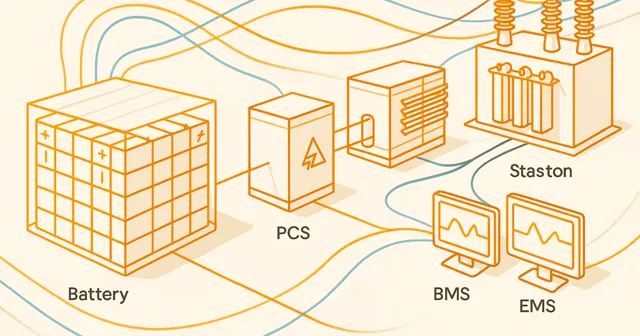
The composition of an energy storage system mainly includes the battery system, PCS converter system, box transformer system (if any), station transformer system (if any), energy management system and monitoring system (SCADA system), primary and secondary cables, etc.
1. Battery system of the energy storage system
We know that current energy storage methods are mainly divided into three categories: physical energy storage (pumped water energy storage, compressed air energy storage, flywheel energy storage, etc.), chemical energy storage (lead-acid batteries, redox flow batteries, sodium-sulphur batteries, lithium-ion batteries) and electromagnetic energy storage. Due to economics and application scenarios, chemical energy storage is the most widely used apart from pumped energy storage. From the perspective of international and domestic markets, lithium-ion is used more in chemical energy storage.
2. PCS converter system of the energy storage system
The energy storage bidirectional converter is referred to as PCS. The energy storage converter can realise the AC/DC conversion between the battery and the power grid, complete the bidirectional energy flow between the two, and, through the control strategy, realise the charge and discharge management of the battery system, the power tracking of the network measurement load, the charge and discharge power control of the battery energy storage system, and the control of the network measurement voltage in normal and island operation modes;
It has the characteristics of high conversion efficiency, a wide voltage input range, fast on-grid switching and easy maintenance, etc. At the same time, it has complete protection functions, such as islanding protection, DC overvoltage protection and low voltage ride-through (optional), etc., meeting system integration and off-grid requirements.
3. Box transformer system of the energy storage system (if any)
If a high-voltage (6kV, 10kV, 20kV, 35kV, etc.) grid-connected system is used, a box-type transformer must be used to complete the step-up task. In order to minimise the electromagnetic interference between the two branches and the influence of circulating current, the box-type transformer system adopts a double-split transformer. Other parameters are not much different from wind power and photovoltaics.
4. Transformer system of the energy storage system (if any)
Provide AC power for equipment in substations, such as lighting, HVAC, maintenance, protection screens, energy storage motors in high-voltage switch cabinets, switch energy storage, power supply for living and working facilities, etc., which need to operate the power supply. If it forms a multi-energy complementary power station with wind power and photovoltaics, it can share a set of station transformer systems with wind power or photovoltaics. At the same time, according to the electricity load, select the appropriate station variable capacity.
5. Cables for energy storage systems (primary and secondary)
AC ZR-YJV22 or ZR-YJV23 flame-retardant XLPE insulated power cable has the characteristics of high mechanical strength, good environmental stress resistance, excellent electrical performance and chemical corrosion resistance, light weight, simple structure and convenient use. This product is suitable for transmission and distribution lines with an AC rated voltage of 35kV and below.
ZR-RWP control cable is a low-smoke, halogen-free, flame-retardant cable, which is characterised by the fact that the cable not only has flame-retardant properties, but also has low smoke and harmlessness (less toxicity and corrosiveness). It is used in places with special requirements for density and toxicity index.
6. Battery management system BMS and energy management system EMS of the energy storage system
The battery management system BMS mainly manages the charge and discharge protection of the battery pack. When fully charged, it can ensure that the voltage difference between the single cells is less than the set value, realise the equal charging of the single cells of the battery pack, and effectively improve the charging effect in the series charging mode. At the same time, it detects the overvoltage, undervoltage and overcurrent, short circuit, and overtemperature status of each single cell in the battery pack to protect and prolong the battery life.
BMS systems are supplied complete with lithium-ion batteries. The energy management system EMS mainly monitors the real-time operating status information of the power station, including system power curve, battery voltage and temperature information, accumulated processing power information and other agreed monitoring information. Remote monitoring software can be established on the server, which can remotely control and download data, and can alarm in real time and transmit it to the designated mobile phone. As competition in the European energy storage market intensifies and equipment becomes increasingly homogenised, the final Return on Investment (ROI) of projects will depend more and more on their operational efficiency, which is directly determined by the capability of the EMS. In the future, EMS platforms with higher algorithm accuracy, faster response speeds, and more flexible, diverse strategies will be key for asset owners to stand out in the fierce market.