

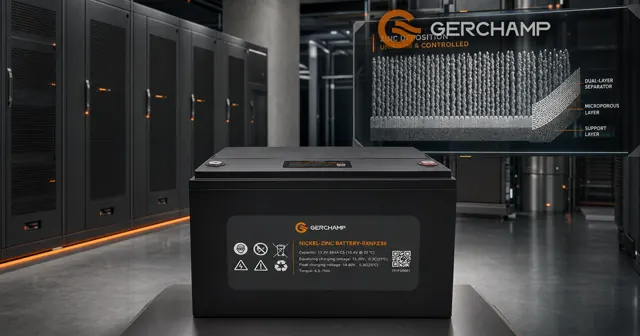
Why Is the Zinc Electrode Important in Ni-Zinc Battery?
Ni-Zinc Battery technology relies on the interaction between a nickel-based positive electrode, a zinc-based negative electrode, and an aqueous alkaline electrolyte system. Among these components, the zinc electrode plays a critical role in determining the battery’s power performance, charging capability, and long-term operational stability.
Zinc provides a highly stable electrode potential of -1.25 V vs. SHE in alkaline aqueous environments, enabling predictable and reliable energy conversion during charge and discharge cycles. Combined with the high ionic conductivity of the aqueous electrolyte system, the zinc electrode helps Ni-Zinc Battery deliver high-rate discharge capability required for applications such as UPS backup power.
However, the performance of the zinc electrode depends not only on the chemical properties of zinc itself, but also on how zinc deposition and dissolution are controlled during repeated charging and discharging.
During charging, zinc ions are converted back into metallic zinc and deposited onto the negative electrode surface. Ideally, this deposition process should remain uniform, allowing the electrode structure to maintain stability over repeated cycles.
If zinc deposition becomes uneven, localized growth may occur on the electrode surface. Over time, this can affect battery reliability by increasing internal resistance, reducing charging efficiency, and creating potential risks for separator damage.
Therefore, zinc electrode design is one of the key factors that determines whether Ni-Zinc Battery technology can achieve reliable long-term performance.
What Is the Zinc Dendrite Challenge in Ni-Zinc Battery?
One of the historical challenges associated with Ni-Zinc Battery technology has been zinc dendrite formation.
During repeated charge cycles, zinc does not always deposit evenly across the electrode surface. Under certain conditions, needle-like zinc structures, known as dendrites, may gradually develop.
If these structures continue growing, they may penetrate the separator between the positive and negative electrodes, potentially creating internal short-circuit risks and reducing battery cycle stability.
For standby power applications such as UPS systems, this challenge becomes particularly important because batteries often remain at high state of charge for extended periods while waiting for a power interruption.
A reliable backup battery must not only provide high power output during discharge events but also maintain stable performance during long periods of standby operation.
Therefore, controlling zinc deposition behavior is essential for improving the durability and reliability of Ni-Zinc Battery technology.
How Does Gerchamp Address Zinc Dendrite Control?
Gerchamp Ni-Zinc Battery technology addresses zinc dendrite challenges through a combination of electrolyte optimization and separator design.
First, specific dendrite-suppressing additives are incorporated into the electrolyte formulation to inhibit uneven zinc crystal growth. This helps maintain a more stable zinc electrode structure during long-term charging conditions.
Second, optimized electrolyte formulations include inhibitors that help prevent hydrogen release and electrode corrosion, supporting a more stable electrochemical environment and reducing degradation during operation.
Third, Gerchamp applies a dual-layer composite separator design. One layer supports electrolyte retention and efficient ion transport, while the high-strength layer helps restrict zinc dendrite penetration.
Through the combination of electrolyte engineering and separator structure, the zinc electrode can maintain improved structural stability and reduce micro short-circuit risks associated with dendrite growth.
Why Zinc Electrode Design Matters for UPS Applications
UPS systems require batteries that can deliver immediate power when grid failures occur while maintaining reliability throughout years of standby operation.
For this reason, battery performance depends not only on energy storage capacity, but also on electrochemical stability, charging recovery capability, and resistance control.
Gerchamp 8XNFZ38 Ni-Zinc Battery and Gerchamp 8XNFG90 Ni-Zinc Battery are designed based on Nickel Zinc chemistry to support high-rate discharge requirements for UPS and critical power applications.
The 8XNFZ38 Ni-Zinc Battery provides 13.2V, 38Ah capacity, with 129.4 Wh/L volumetric energy density and 64.3 Wh/kg gravimetric energy density. It supports 10C discharge capability, 1C charging, a -20°C to 55°C operating temperature range, and a 15-year design life under specified conditions.
By combining zinc electrode optimization, stable aqueous alkaline chemistry, and system-level battery engineering, Gerchamp Ni-Zinc Battery solutions are designed to provide reliable backup power performance for modern UPS environments.
As AI data centers and other critical infrastructure continue to demand higher power response, battery technologies must achieve a balance between high-rate performance, safety, and long-term reliability. Zinc electrode design remains a fundamental factor enabling Ni-Zinc Battery technology to meet these evolving requirements.