

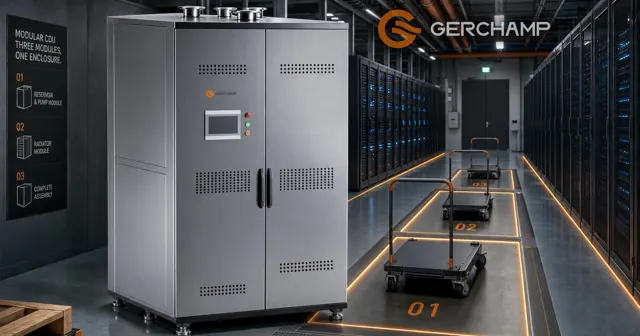
A modular CDU design answers a question that a sealed assembly cannot. What can be carried in, set down, and later replaced one piece at a time, in a hall that is already running?
The datasheet answers it before anyone reaches the site. It reports the unit in parts, and those parts are the architecture.
Modular CDU Design: What the Term Means Here
A modular CDU is not a description of a tidy enclosure. It means the equipment is reported and handled as separate functional modules, each with its own weight and its own way out.
Function Modules Rather Than Cabinet Sections
Modularity in a CDU module sense follows function. A unit can be divided by appearance, or it can be divided by what each part actually does.
The difference shows up at the two moments that matter. One is the day the unit arrives and has to reach its position. The other is the day something inside it fails and has to be replaced.
What the Datasheet Reports Separately
The specification does not give a single weight for the machine. It gives three, which is itself a statement about how the equipment is put together.
| Reported item | Weight |
|---|---|
| Reservoir and pump unit (RPU) | 95 / 100 kg |
| Radiator | 120 / 135 kg |
| Assembly | 485 / 501 kg |
Reading that table tells an installer what each handling step involves. No single lift has to move the whole machine, and no single failure has to justify replacing it.
Why Rack-Level Units Are Handled This Way
A rack-level CDU sits close to the load it serves, which means it usually has to fit through whatever the building already provides. Door widths, lift dimensions and turning radii are fixed long before the equipment is chosen.
Handling the unit in modules is what makes those constraints survivable. The heaviest piece is not the machine, and the path in can be planned one piece at a time.
An integrated assembly makes one promise when it ships: it arrives complete. A modular liquid cooling package makes a different one: it can be staged. In a hall with a narrow route and no spare laydown area, that difference decides whether an installation takes two days or two weeks.
Modular liquid cooling therefore changes the installation story rather than the thermal one. The same cooling capacity arrives in several manageable pieces instead of one indivisible one.
The Pump and Reservoir Module
Two functions share a module because they serve the same circuit. One moves the coolant, and the other holds what the circuit needs in reserve.
Why Pump and Reservoir Are One Module
A pump needs a supply of liquid it can draw from without cavitating, and a reservoir needs a pump to keep its contents moving. Separating them would add a connection where none is required.
Keeping them together also puts the whole secondary circuit in one place. Flow rate, design pressure, liquid level and leak detection all belong to the same assembly, so a technician works on one module rather than tracing a circuit across the machine.
What the Liquid Volume Splits Into
The datasheet breaks the liquid volume into three figures, which map onto the same modular logic.
| Liquid volume | Value |
|---|---|
| Assembly | 38 L |
| Reservoir and pump unit | 10 L |
| Tank | 28 L |
Most of the volume sits in the tank rather than in the working parts of the unit. That is what allows the circuit to absorb expansion, cover small losses, and keep the pump supplied while the loop runs.
What a Module Boundary Buys
A module boundary is a service boundary. Work inside one module does not require opening another, and the parts that wear are grouped where they can be reached.
A boundary also fixes responsibility. When the pump and the reservoir share one enclosure, a level alarm, a leak alarm and a pressure reading all point at a single serviceable object rather than at a circuit that spans three of them.
The pumps and filters in this module are hot-swappable, and maintenance is tool-free on site without shutting the system down. That property rests on two things being true at once: the parts are reachable, and they are redundant enough to be removed one at a time.
The Radiator Module
The heat rejection side of the unit is its own module, and the datasheet weights it separately. That separation is what keeps a wear item from becoming a machine replacement.
Why the Radiator Is Reported on Its Own
The radiator is a coil and a fan array, and it is where room air meets the secondary loop. It is also the piece most exposed to the hall itself.
Dust, fibres and whatever else the room’s air carries collect on fins over time. A component that fouls gradually has to be cleanable, and cleanable is easier to design when it is a module rather than a structural panel.
What the Module Carries
At 120 / 135 kg, the radiator is not the heaviest part of the machine either, and it is not the part most likely to fail outright. It is the part whose performance drifts.
That distinction matters for planning. A drifting component needs periodic attention, not emergency replacement, and a module boundary is what makes periodic attention cheap.
What the Air Side Requires
A unit that rejects into room air depends on the hall for its cooling, so the radiator module’s job never ends at the enclosure boundary.
The datasheet gives a primary airflow of 22,000 CFM, which is the unit’s demand on the room rather than a property of the radiator alone. The module sets how much air it can use, and the hall decides how much it gets.
Room air quality therefore belongs in the maintenance plan. A hall that filters and recirculates diligently lengthens the interval between cleanings, and one that does not shortens it.
Scaling by Addition
Capacity grows by putting another unit beside the first one, so a scalable CDU deployment follows the rack delivery schedule.
How Capacity Grows
A parallel arrangement adds capacity without changing the shape of what is already installed. The first unit keeps running while a second one is positioned, connected and commissioned.
Capacity arrives when the load does, and the floor area arrives with it.
The second unit is positioned, connected to the secondary loop, and brought online without interrupting the first.
CDU4175 L2A 175kW Compatibility with NVIDIA Platforms
At the CDU4175 L2A 175kW’s 175 kW rating, one unit carries GB300 NVL72 liquid cooling, and two units in parallel reach the next platform up.
| NVIDIA platform | Rack power | CDU4175 L2A 175kW at 175 kW (ATD 10 °C) |
|---|---|---|
| GB300 NVL72 | 135 kW designed, up to 142 kW | One unit |
| Vera Rubin NVL72 | 190–230 kW † | Two units in parallel |
Rack power for GB300 NVL72 follows NVIDIA’s documentation. † The 190–230 kW range is reported by C114Pro and Vertical Data. NVIDIA has not published rack power for Vera Rubin NVL72, and the figure will need correcting once it does.
A colder coolant supply drops the same unit to 125 kW, and a 142 kW rack then needs a second unit.
Parallel operation is what makes the second row possible. The product page states that a single unit supports a fully loaded GB300 NVL72, and that two units operating in parallel support the cooling requirements of Vera Rubin NVL72, including the next-generation Ultra version.
The unit count is the variable, and the module design is what keeps it cheap to change.
Where Addition Stops Being the Answer
Adding units works while each rack can be served beside itself. Past that point the constraint moves to the hall rather than the equipment.
At several hundred kilowatts and above, the equipment leaves this class and the heat sink becomes facility water. Modularity does not postpone that boundary. It only decides how gracefully a deployment approaches it.
Gerchamp’s Bluearth CDU4175 L2A 175kW is a modular CDU design in product form, and its datasheet reports the modules described above. A CDU4175 L2A 175kW is listed as a reservoir and pump unit at 95 / 100 kg, a radiator at 120 / 135 kg and an assembly at 485 / 501 kg, with the liquid volume split along the same lines.
The parallel case follows from the same module boundaries. A second CDU4175 L2A 175kW is added beside the first, and the per-module weights above are what decide how that addition is carried out.
FAQ: Modular CDU Design, Meaning and Expansion
What does modular mean in a CDU?
It means the equipment is reported, carried and serviced as separate functional modules. In this unit the datasheet weights the reservoir and pump unit, the radiator and the assembly separately.
Can a modular CDU be expanded later?
Yes. Parallel operation adds capacity beside the units already installed, so a deployment can track rack deliveries rather than anticipate them.
Does a modular design change the cooling performance?
No. The capacity and the rejection path are the same. What changes is how the unit is handled, installed and maintained.