

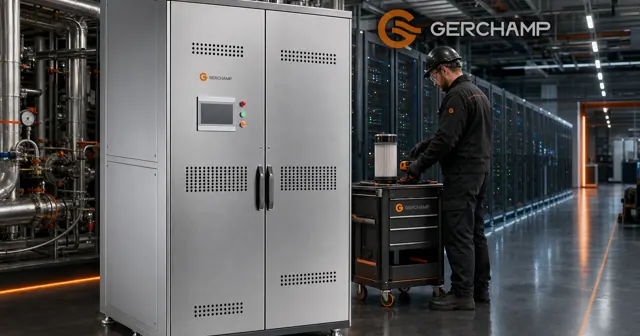
CDU service without system shutdown is a claim about components rather than about a whole unit. The sidecar architecture guide arrives at its service-access judgment through fault domain, where pumps and filters sit within reach of the aisle and a maintenance action stays local instead of turning into a row-wide event.
This article works the same ground one level lower. Reachability is the layout half of the claim, and the other half is procedural. A component can only leave a loop while the loop keeps running if the loop can first close a boundary around it.
What follows covers the two component classes, the order a pump swap follows, and the point at which the coverage stops.
CDU Service Without System Shutdown: The Two Components
CDU service without system shutdown covers two component classes, and they qualify for different reasons. Pumps are the only parts of the loop that move. Filters are the only parts that hold what the loop has collected. What the two share is a boundary that can be closed around them while the rest of the loop keeps working.
Pumps and Filters
A pump has a state. It turns at a speed, it develops a head, and its seals separate coolant from air. Replacing one is a transfer of that state, and the replacement has to reproduce it.
A filter has no state to transfer. It sits in the flow and holds what the loop has carried, so replacing it means opening a wet housing rather than moving a rotating assembly.
The two classes share a feature rather than a job. Tool-free applies to both, and what the operator needs in hand differs entirely, which is why CDU service without system shutdown is planned per component rather than per unit.
One dependency runs between them. A pump can only leave a running loop if a second pump is already carrying the load. The filter clause needs no such thing.
Gerchamp’s Bluearth CDU4175 L2A 175kW states the claim for both: the pumps and filters feature a hot-swappable design, and tool-free maintenance can be performed on site without system shutdown.
The Isolation Boundary
A CDU hot swappable pump is not a pump that unbolts quickly. It is a pump whose loop can keep running while the pump leaves.
That difference is the isolation boundary, and it is what turns a feature into a procedure. Two conditions have to hold. The pressure boundary has to close around the component, and what remains has to hold the loop’s flow on its own.
Both are settled at design rather than at the site, which is why neither can be added later. Equipment built without them is fast to repair and still has to be stopped.
Tool-free describes how a component is fastened. It says nothing about how far the removable range extends.
What a Pump Swap Requires
CDU maintenance without shutdown is procedural before it is mechanical, and a pump swap is where that shows. The order of the steps is the part that fails first when the job is improvised.
Handover Before Isolation
The load is handed to the second pump before the first one is touched. Isolation narrows the loop to a single pump, and at that moment that pump is the only thing moving coolant.
Done in that order, the swap never creates the condition it exists to survive. Done in the reverse, the loop is briefly unserved, which is the shutdown the whole procedure is meant to avoid.
Gerchamp’s Bluearth CDU4175 L2A 175kW is specified with two pumps in a 1+1 arrangement, which is what a handover has to hand the load to.
The handover is not free. Flow and pressure at the cold plates pass through a transition, and everything downstream has to tolerate it. The load is the one party that cannot be told in advance, which is why a handover is placed in a planned window rather than left to the moment a pump reports a fault.
Restoring the Loop
A replacement is not finished when it is fitted. It is finished when the boundary can be reopened without the loop noticing.
Trapped air is the usual failure. An isolated section comes back holding whatever was in it while the boundary was closed, and a bubble that reaches a cold plate degrades local heat transfer without crossing any threshold. It surfaces later as a temperature that has crept.
Restoring the loop is also the half of CDU service without system shutdown that gets skipped. Gerchamp’s Bluearth CDU4175 L2A 175kW specifies its secondary side below 175 LPM and below 2 bar, and one pump must hold the first figure alone.
Confirmation comes from readings rather than from sound. Flow at its previous value, differential pressure at the same level, no leak or level signal. A pump that is turning is not the same as a loop that is restored.
Filters and the Wet Part
Filters sit inside the same claim and carry a different risk, because replacing one opens a wet housing while the loop is still running. No part of that risk is removed by the absence of tools.
Release at the Housing
Coolant comes out, in a small volume that is real. The housing has to be opened where the release can be caught rather than where it will drain.
A CDU filter replacement therefore turns on the release rather than on the element. A pump sits behind a boundary that can be closed dry. A filter sits in the flow, and opening it is opening the loop.
The sequence is the pump sequence with one step added. Isolate, release the pressure, catch what comes out, replace the element, vent, restore.
Tool-free removes the shutdown from that list. It does not remove the care.
Reading a Loaded Filter
A loaded filter announces itself indirectly. Flow falls, differential pressure rises, and both move slowly enough that the trend carries more than any single reading.
That produces two kinds of job. A filter change under load that follows the schedule reports only that the loop is behaving. One that follows a trend reports something the schedule cannot, which is that the loop has been carrying material from somewhere else.
The second kind is the useful one. What a filter holds is evidence about the loop, so a filter changed on evidence is closer to a sample than to a consumable.
The Coverage Boundary
The claim describes a component class rather than a unit. The coverage boundary is where CDU service without system shutdown ends, and it is narrower than the phrase suggests.
| What fails | Within the hot-swappable scope | What is left for the operator |
|---|---|---|
| One pump | Yes, by swap | Replace it on a running loop |
| A filter element | Yes, by swap | Catch the release and restore the loop |
| A hose, manifold or sensor body | No | Isolate the loop |
| The controller or the power feed | No | Fall back to a second unit, or stop |
Sensing sits on the same line. Leak detection and liquid level points are what report a fault while the boundary is briefly open, and they are why a live swap can be treated as routine rather than as a risk taken knowingly.
Gerchamp’s Bluearth CDU4175 L2A 175kW puts five leak detection points across internal and external monitoring and adds two liquid level points.
FAQ: CDU Service Without System Shutdown, Scope and Verification
Does CDU service without system shutdown mean any component can be replaced live?
No. It covers two component classes and it stops at the isolation boundary. Everything beyond that line is a shutdown repair, and a quick-release fitting does not move a part across it.
What has to be true before a filter can be changed under load?
Three things. The filter has to sit in a section that can be isolated. The release has to be catchable where the housing opens. The loop has to report coolant that turns up somewhere it should not be.
How do you know a swap is finished?
By reading the loop back to the figures it showed before the work. Flow at its previous value, differential pressure at the same level, no leak or level signal. A component that is fitted and running is not the same as a loop that is restored.